RoHS, REACH, Conflict Minerals and PFAS: A Compliance Map for Film Capacitor Buyers
In this article
- The map in one picture
- RoHS: ten substances, homogeneous materials
- REACH: candidate list, restrictions and SCIP
- Conflict minerals: who is actually obliged
- PFAS: where the universal restriction stands in 2026
- PCBs: the old problem with a 2025 deadline
- Checklist: documents to request
- Conclusion
- HYDRA compliance documents
- References
A request for quotation for a film capacitor can come with questions about substances and sourcing as well as electrical data. Is the part RoHS compliant, with or without exemptions? Does it contain a substance of very high concern? Where does the tin come from? And does it contain PFAS?
Each question rests on a different legal instrument, with a different obligated party and a different document as evidence. This article maps the main ones for metallized polypropylene film capacitors and ends with a checklist of documents a buyer can reasonably request.
Key takeaways
- Each question rests on a different legal instrument, with a different obligated party and a different document as evidence.
- A buyer who knows which instrument is behind each question can ask for the right document and check that it is dated against the right list version.
- The final word on a specific part belongs to the supplier's signed documents, not to general guidance.
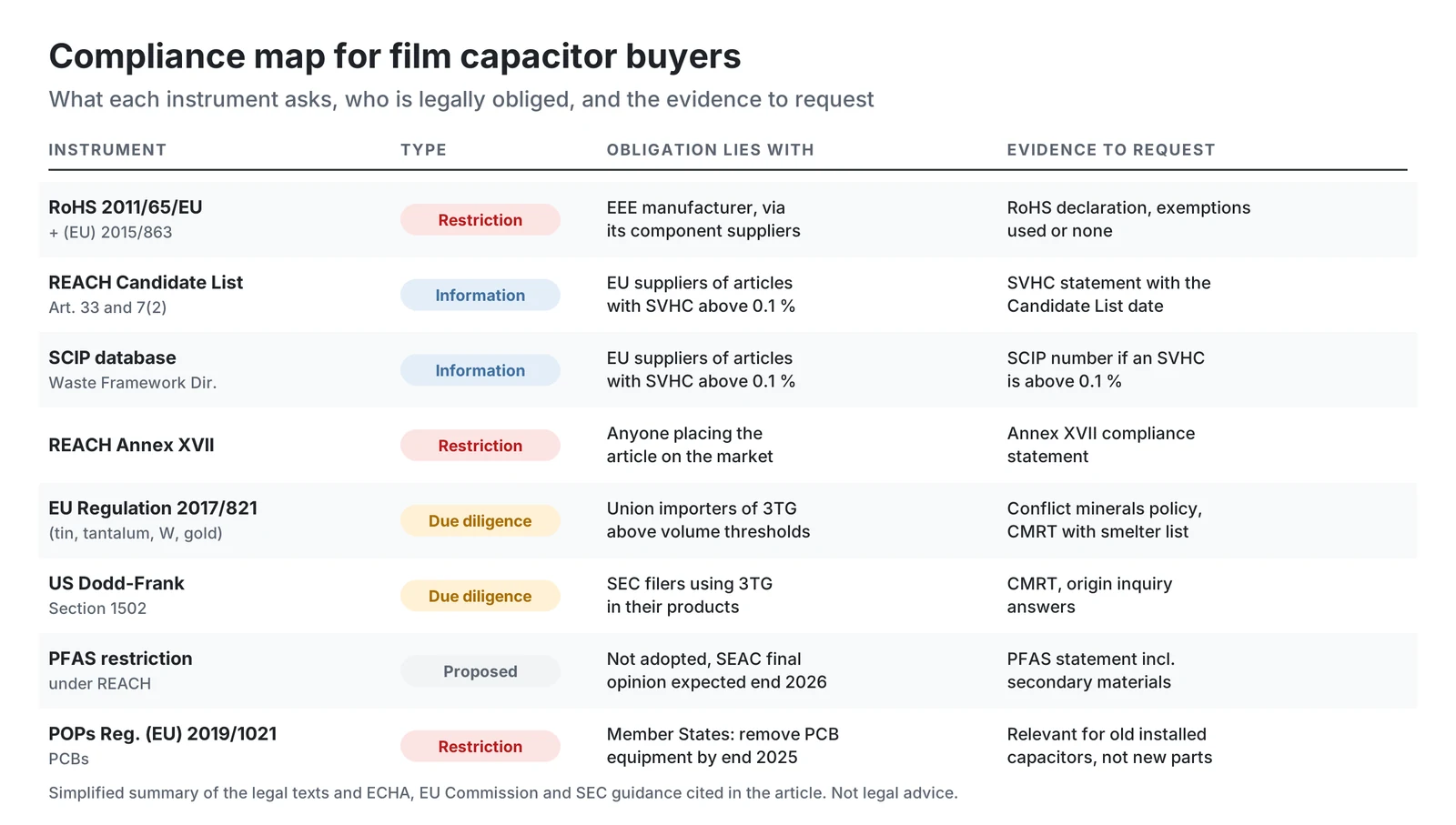
The map in one picture
The instruments fall into three groups. Substance restrictions (RoHS, REACH Annex XVII and the POPs Regulation) forbid certain substances above a limit. Information duties (REACH Article 33 and the SCIP database) do not forbid anything but require the supplier to tell customers and authorities when a listed substance is present. Supply chain due diligence (the EU Conflict Minerals Regulation and US Dodd-Frank Section 1502) concerns the origin of tin, tantalum, tungsten and gold rather than the composition of the part. The proposed universal PFAS restriction will, if adopted, join the first group.
RoHS: ten substances, homogeneous materials
The RoHS Directive 2011/65/EU requires that electrical and electronic equipment placed on the EU market, including cables and spare parts, does not contain the substances listed in its Annex II above the maximum concentration values. The limit applies per homogeneous material, defined as a material of uniform composition throughout, or a combination of materials that cannot be separated by mechanical actions such as unscrewing, cutting, crushing, grinding and abrasive processes. Applied to a capacitor, the limits are therefore checked material by material, not on the part as a whole.
Commission Delegated Directive (EU) 2015/863, often called RoHS III, amended Annex II and added four phthalates: DEHP, BBP, DBP and DIBP. The restriction of these phthalates applies from 22 July 2019, and from 22 July 2021 for medical devices and monitoring and control instruments. The result is ten restricted substances. Nine are limited to 0.1 % by weight in a homogeneous material, cadmium to 0.01 %.
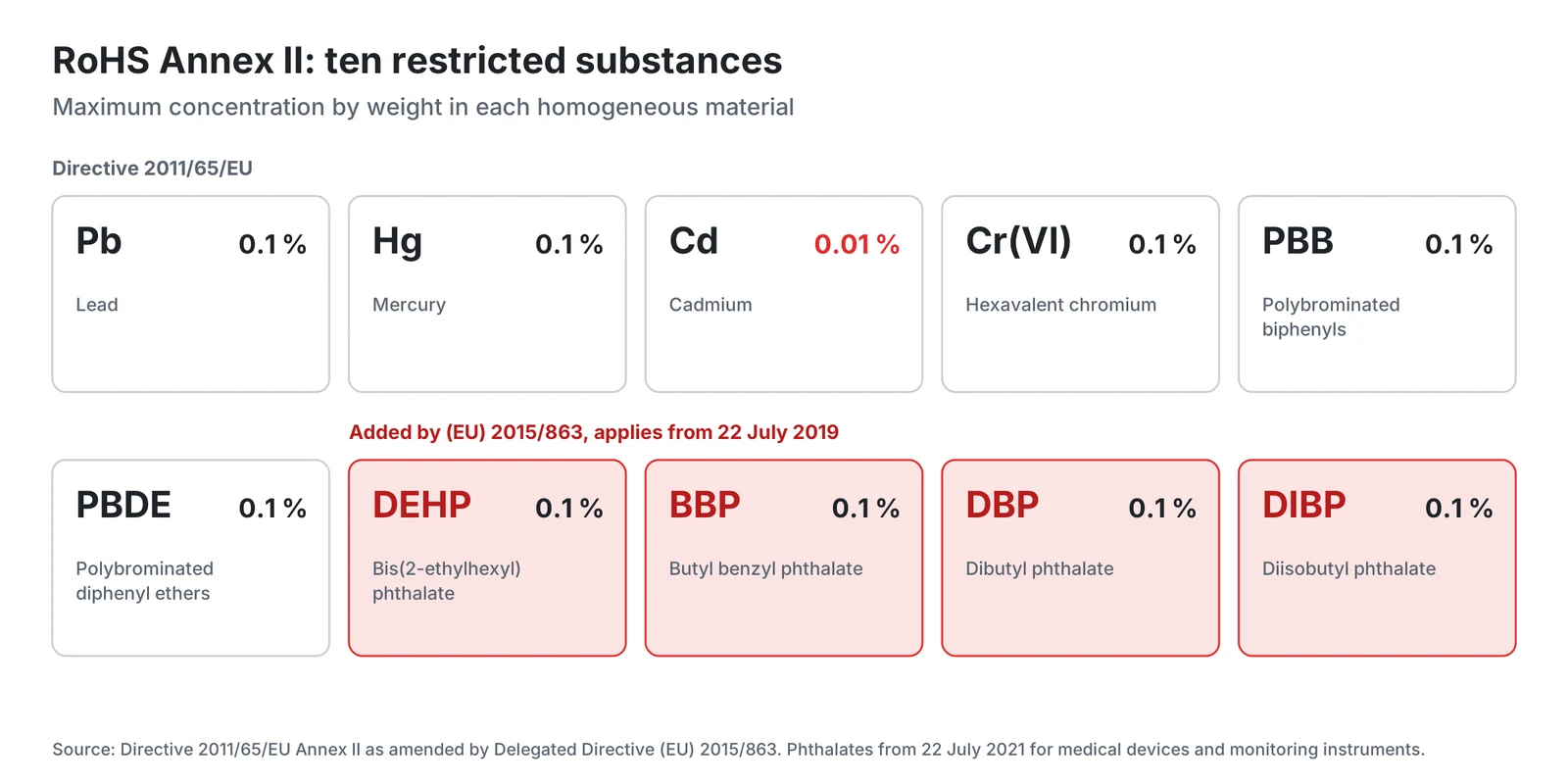
Two details matter in practice. First, Annexes III and IV list exemptions for applications where substitution is not yet possible, some of them for lead in glass or ceramic parts of electronic components. A declaration should therefore say whether the part is compliant with or without exemptions, and name them if any are used. Second, the manufacturer of the equipment must keep the technical documentation and the EU declaration of conformity for ten years after the equipment is placed on the market.
REACH: candidate list, restrictions and SCIP
REACH, Regulation (EC) No 1907/2006, affects capacitors in two ways that are often confused.
The first is the Candidate List of substances of very high concern (SVHC). It does not ban anything. If an article contains a Candidate List substance above 0.1 % weight by weight, its supplier must give the recipient enough information to allow safe use (Article 33), and must answer a consumer request free of charge within 45 days. Producers and importers must also notify ECHA if the substance exceeds 0.1 % and the total quantity in their articles exceeds one tonne per year, six months after the substance is added to the list (Article 7). Since 5 January 2021 the Waste Framework Directive, as amended by Directive (EU) 2018/851, additionally requires that suppliers of such articles provide the Article 33 information to ECHA, which collects it in the SCIP database. According to SGS, ECHA's update of February 2026 brought the Candidate List to 253 entries. Any SVHC statement is therefore only meaningful together with the list version it refers to.
The second is Annex XVII, the list of restrictions, which does prohibit or limit the manufacture, placing on the market or use of specific substances, mixtures and articles.
Conflict minerals: who is actually obliged
EU Regulation 2017/821 covers tin, tantalum, tungsten and gold. Its due diligence, audit and reporting obligations apply from 1 January 2021 to Union importers of these minerals and metals above annual volume thresholds set in its Annex I. According to the European Commission, downstream companies operating beyond the metal stage have no obligations under the regulation but are expected to use reporting and other tools to make their due diligence more transparent. In the US, the SEC rule implementing Section 1502 of the Dodd-Frank Act requires companies that file reports with the SEC and manufacture products in which these minerals are necessary to inquire into their origin and file Form SD by 31 May each year. Downstream, the request reaches suppliers through the Conflict Minerals Reporting Template (CMRT), a free standardized template from the Responsible Minerals Initiative that records the smelters and refiners in the supply chain.
Tantalum explains why the capacitor industry is so familiar with this topic. Tantalum is used in electronic capacitors, and according to the USGS the Democratic Republic of the Congo and Rwanda produced an estimated 1,300 t and 400 t of the world's 2,500 t mine output of tantalum in 2025, together 1,700 t or 68 % (1,700 / 2,500). Metallized polypropylene capacitors are not outside the scope either: HYDRA's conflict minerals policy states that the company uses one of the conflict minerals, tin, in production, and it asks suppliers to determine the source and chain of custody of any products containing conflict minerals.
PFAS: where the universal restriction stands in 2026
The proposal to restrict per- and polyfluoroalkyl substances under REACH was submitted by Denmark, Germany, the Netherlands, Norway and Sweden in January 2023 and, according to Covington, would ban over ten thousand substances. ECHA published an updated version on 20 August 2025, with derogated uses expanded from 26 to 74 according to Jones Day. The Committee for Risk Assessment adopted its final opinion on 2 March 2026, and the Committee for Socio-Economic Analysis agreed its draft opinion in March 2026. The consultation on the SEAC draft ran until 25 May 2026, and the final SEAC opinion is expected by the end of 2026. Covington considers a Commission decision unlikely before the third quarter of 2027 and expects restrictions to apply no earlier than 2029.
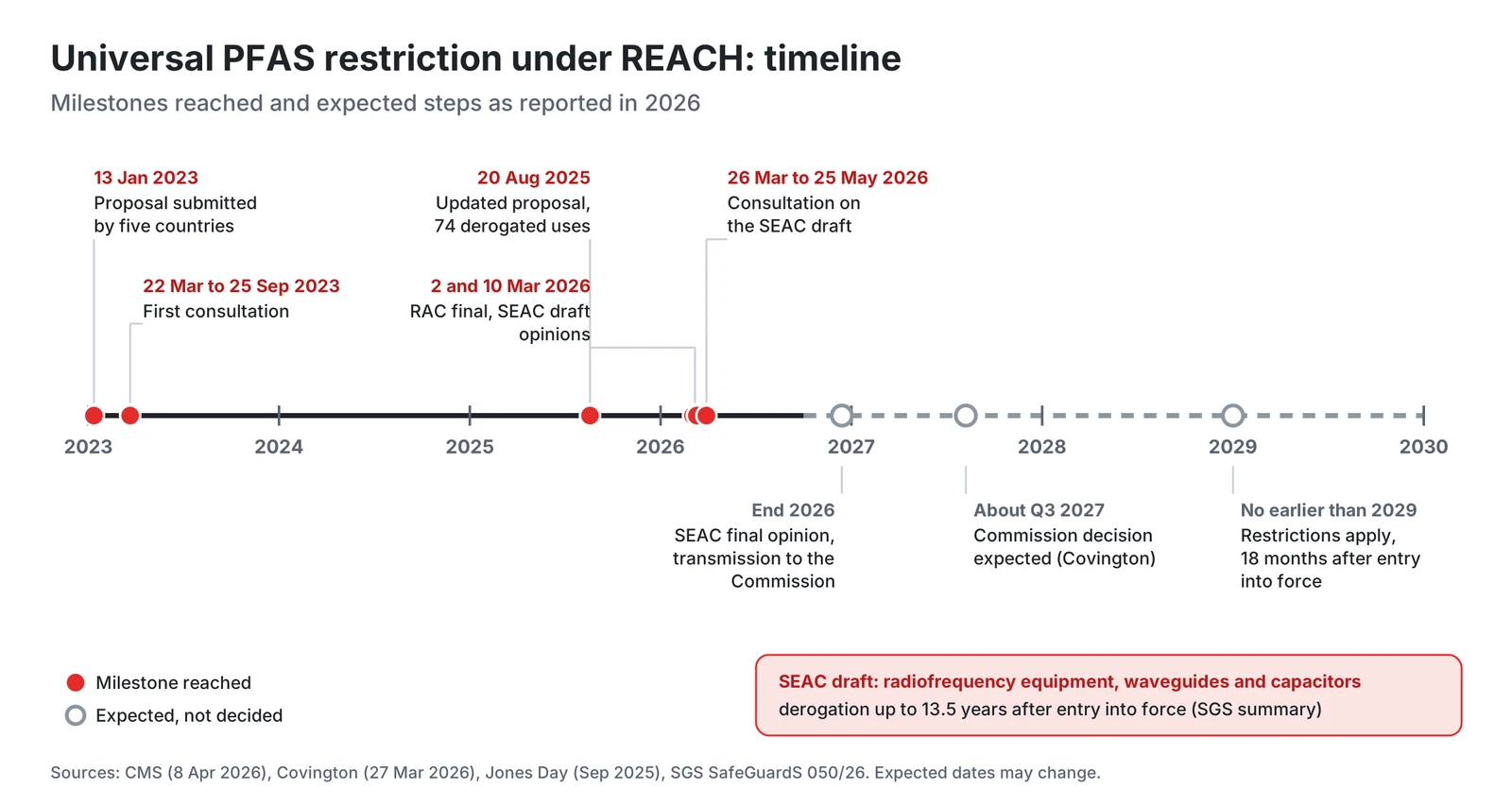
For the capacitor industry one line in the SEAC draft stands out. According to the SGS summary, it contains a derogation for radiofrequency equipment, waveguides and capacitors lasting up to 13.5 years after entry into force, while the general prohibition would apply 18 months after entry into force. The draft also sets article limits of 25 ppb for an individual PFAS, 250 ppb for the sum of PFAS and 50 ppm for total PFAS including polymeric PFAS. The text can still change.
Under the proposal, a PFAS is a substance that contains at least one fully fluorinated methyl or methylene carbon atom, according to the SGS summary. HYDRA's motor run, PFC, DC-link and AC filter capacitors use metallized polypropylene film as the dielectric, and the HYDRA 2025 catalogue lists vegetable oil, soft resin or dry resin as the filling. A PFAS question to any capacitor supplier should still cover the secondary materials, such as wire insulation, sleeves, gaskets and process aids, because the limits in the SEAC draft apply to articles, not only to the dielectric.
PCBs: the old problem with a 2025 deadline
Polychlorinated biphenyls were used mainly as insulating fluids in transformers and also in capacitors. Under the Stockholm Convention, parties were to make determined efforts to identify, label and remove from use equipment containing PCB by 2025, and to manage PCB liquids and contaminated equipment in an environmentally sound way no later than 2028. In the EU, the POPs Regulation (EU) 2019/1021 requires Member States to remove from use equipment containing more than 0.005 % PCBs in volumes greater than 0.05 dm³ no later than 31 December 2025.
Checklist: documents to request
- RoHS declaration citing 2011/65/EU and (EU) 2015/863, dated and signed, stating whether any Annex III or IV exemption is used.
- REACH SVHC statement naming the Candidate List version or date it refers to, with the Article 33 information if any SVHC exceeds 0.1 %, and the SCIP number where applicable.
- REACH Annex XVII statement confirming compliance with the restrictions relevant to the part.
- Conflict minerals policy and a current CMRT listing the smelters for tin and any other 3TG present.
- PFAS statement covering the dielectric and all secondary materials, with the reference date of the information.
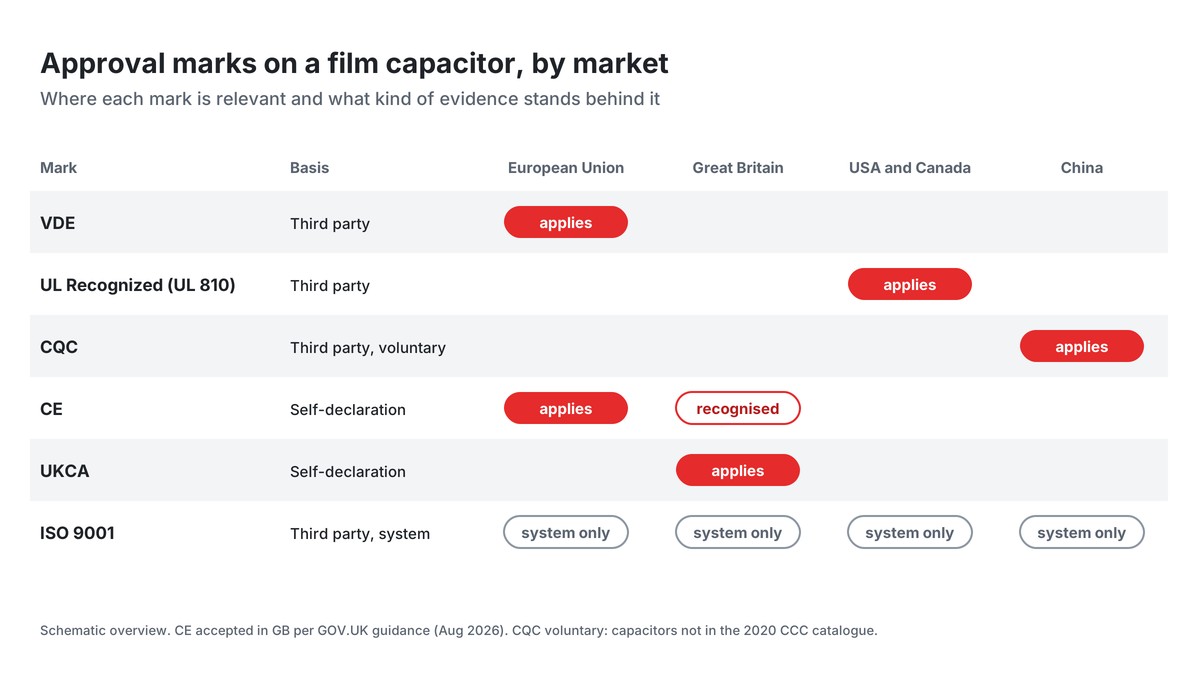
- Declarations for the target market, for example UKCA for Great Britain, alongside the approvals for the application.
- Validity and scope: check that each document is current, covers the exact series and plants supplying the part, and is renewed when the lists change.
HYDRA publishes these documents on its documents page: a RoHS certificate of conformity dated 1 January 2026 stating conformity without exceptions with 2011/65/EU and (EU) 2015/863, a REACH certificate of conformity dated 2 March 2026 that refers to the 253-entry Candidate List and Annex XVII, the conflict minerals policy of January 2026 and a UKCA declaration for motor capacitors.
Conclusion
RoHS and REACH Annex XVII forbid substances above set limits, the REACH Candidate List and SCIP require disclosure, the conflict minerals rules concern the origin of metals and oblige mainly importers and listed companies, and the PFAS restriction is still a proposal with a capacitor derogation in the current draft. A buyer who knows which instrument is behind each question can ask for the right document and check that it is dated against the right list version. The final word on a specific part belongs to the supplier's signed documents, not to general guidance.
HYDRA compliance documents
HYDRA capacitors use metallized polypropylene film as the dielectric. The RoHS certificate of conformity of 1 January 2026 covers all products supplied by HYDRA a.s. without exceptions, and the REACH certificate of 2 March 2026 refers to the Candidate List of 4 February 2026 with 253 substances and to Annex XVII as updated on 28 July 2025.
| Document | Date | Download |
|---|---|---|
| RoHS certificate of conformity | 1 January 2026 | RoHS 2026 (PDF) |
| REACH certificate of conformity | 2 March 2026 | REACH 2026 (PDF) |
| Conflict Minerals Policy | January 2026 | Conflict Minerals Policy (PDF) |
| UKCA declaration, motor capacitors | 24 July 2024 | UKCA declaration (PDF) |
Further documents:
- Code of Conduct 2026 (PDF)
- All certificates and declarations, including ISO 9001, ISO 14001 and ISO 45001
- HYDRA capacitors catalogue 2025 (PDF) with dielectric and filling for each product line
- Contact for a CMRT or a part-specific declaration
References
- Directive 2011/65/EU of the European Parliament and of the Council of 8 June 2011 on the restriction of the use of certain hazardous substances in electrical and electronic equipment (RoHS), Articles 3(20), 4 and 7 and Annex III. EUR-Lex.
- Commission Delegated Directive (EU) 2015/863 of 31 March 2015 amending Annex II to Directive 2011/65/EU. EUR-Lex.
- Regulation (EC) No 1907/2006 (REACH), Articles 7 and 33. EUR-Lex.
- Directive (EU) 2018/851 amending Directive 2008/98/EC on waste, Article 9(1)(i) and 9(2). EUR-Lex.
- SGS, SafeGuardS 021/26: ECHA expands Candidate List to 253 SVHCs, February 2026. SGS.
- Regulation (EU) 2017/821 of the European Parliament and of the Council of 17 May 2017 laying down supply chain due diligence obligations for Union importers of tin, tantalum and tungsten, their ores, and gold, Articles 1 and 20. EUR-Lex.
- European Commission, Conflict Minerals Regulation: the regulation explained. European Commission, DG Trade.
- 17 CFR 240.13p-1. Cornell LII. U.S. Securities and Exchange Commission, Conflict Minerals, final rule, Federal Register 77 FR 56274, 12 September 2012 (PDF) (Form SD due by May 31 of each year). GovInfo.
- Responsible Minerals Initiative, Conflict Minerals Reporting Template (CMRT). RMI.
- U.S. Geological Survey, Mineral Commodity Summaries 2026: Tantalum. USGS.
- SGS, SafeGuardS 050/26: ECHA consults over SEAC's draft opinion on PFAS restrictions under REACH, 7 April 2026. SGS.
- Covington, ECHA launches a new public consultation on a proposed universal ban on PFAS in the EU, 27 March 2026. Covington & Burling.
- Jones Day, ECHA publishes updated PFAS REACH restriction proposal, September 2025. Jones Day.
- Polimerica, SEAC clears draft opinion on PFAS restriction, 11 March 2026. Polimerica.
- Stockholm Convention Secretariat, PCBs overview. Stockholm Convention.
- Regulation (EU) 2019/1021 of the European Parliament and of the Council of 20 June 2019 on persistent organic pollutants, Annex I. EUR-Lex.
- HYDRA a.s., RoHS certificate of conformity 2026, REACH certificate of conformity 2026, Conflict Minerals Policy 2026, UKCA declaration.
- HYDRA a.s., Capacitors catalogue 2025 and PFC capacitor components datasheet ed. 02/13.
Products in this article
Standards, compliance & sourcing
Check stockAsk a HYDRA engineer
Send us your application data and our engineers will help you choose the right film capacitor. HYDRA has made film capacitors since 1899, with production in Jičín (Czech Republic) and Da Nang (Vietnam).
Ask an engineerCheck stock