Counterfeit and Substandard Capacitors: How to Spot Them and Protect Your Supply
In this article
Counterfeit electronic components are mostly reported as integrated circuits, and ICs dominate ERAI's annual statistics. Capacitors are not exempt. A capacitor that carries a false brand, a false rating or a false approval mark may still pass an electrical test, and a product with a counterfeit approval mark has not been evaluated for safety by the certifier whose mark it bears.
This article covers the scale of the problem, the forms counterfeits take, the relevant standards, a practical incoming inspection for film capacitors and a checklist for HVAC technicians.
Key takeaways
- Capacitors made up 3.74 % of the parts reported to ERAI in 2025, a small share that rose again after a period of decline.
- HYDRA recommends buying through authorised channels, checking certificates in the issuers' databases, inspecting unfamiliar lots in stages and asking the manufacturer to verify doubtful parts.
- Electrical tests alone are not enough, because almost a quarter of tested suspect counterfeit parts passed them.
How big is the problem?
One public dataset comes from ERAI, an organisation that collects reports of suspect counterfeit and nonconforming parts from any organisation, regardless of ERAI membership. According to its 2025 Annual Report, 748 parts were reported in 2025, 29.1 % fewer than in 2024. Without a single batch of 248 parts reported by the U.S. Government in May 2024, the decrease was 7.4 %.
Capacitors accounted for 3.74 % of the parts reported in 2025, which corresponds to about 28 parts (0.0374 × 748 = 28.0). The capacitor share over the previous five years was 1.81 % and over ten years 5.56 %. ERAI comments that "the decline in reported nonconforming capacitors appears to have ended", with an upward trend in 2025.
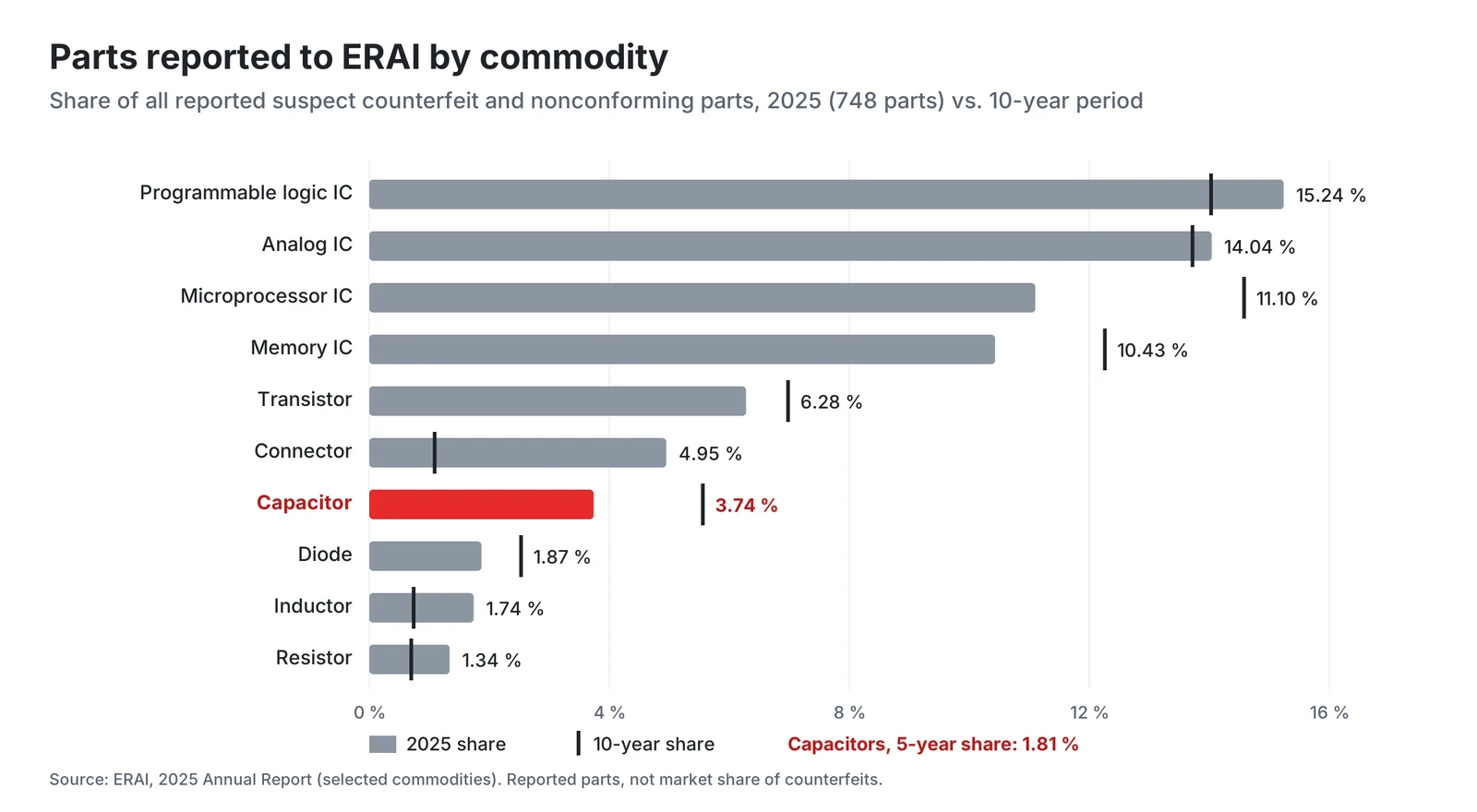
These numbers count reported parts, not the counterfeits circulating in the market, and they mix suspect counterfeit with merely nonconforming parts. In 2025, 55.34 % of reports were classified as suspect counterfeit, 31 % as nonconforming and 13.5 % as both. Reporting is dominated by independent distributors (48.26 %) and third-party test labs (32.17 %), while original component manufacturers contributed 4.02 %. Three findings are directly useful to capacitor buyers:
- Active parts, available through authorised channels at the time, made up 36.15 % of reports. Avoiding obsolete parts is not enough.
- In 2025, 23.37 % of the reported brands were new to the ERAI database. Counterfeiters are moving beyond the best-known names.
- Of the suspect counterfeit parts that were also tested electrically, 24 % passed the electrical test and 12 % failed it. An electrical test alone misses many counterfeits.
What a counterfeit capacitor can be
ERAI's glossary defines the main types. A remarked part is one in which "the original part markings were removed or covered and then marked with a new part marking". A recycled part has been "removed from a used system, repackaged and remarked and then sold in the market as new". A cloned part is "an unauthorized copy of a part produced without the Intellectual Property Rights Holder's knowledge or consent". The glossary cross-references further types, including out-of-spec, overproduced and tampered parts. A forged approval mark is another route, described in the section on approval marks below.
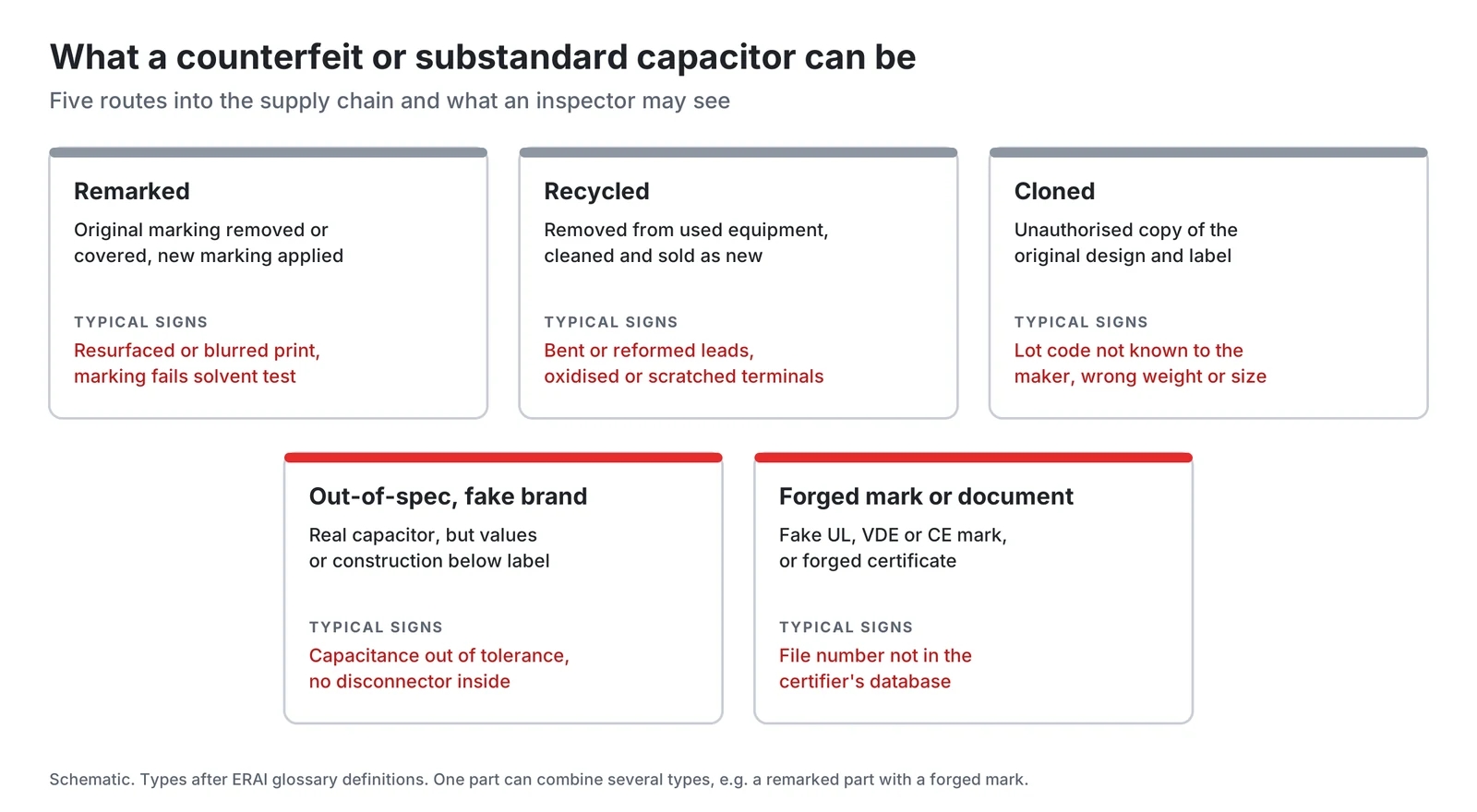
A documented capacitor case illustrates the problem. Shrivastava and Pecht (CALCE, 2014) describe multilayer ceramic capacitors for a military aircraft that failed a high-temperature screening test. Failure analysis showed they "were not made to the correct specifications" and had been sold as authentic military-grade parts of a major manufacturer.
We did not find published, independently measured data on counterfeit motor run capacitors sold online for HVAC service.
Counterfeit approval marks
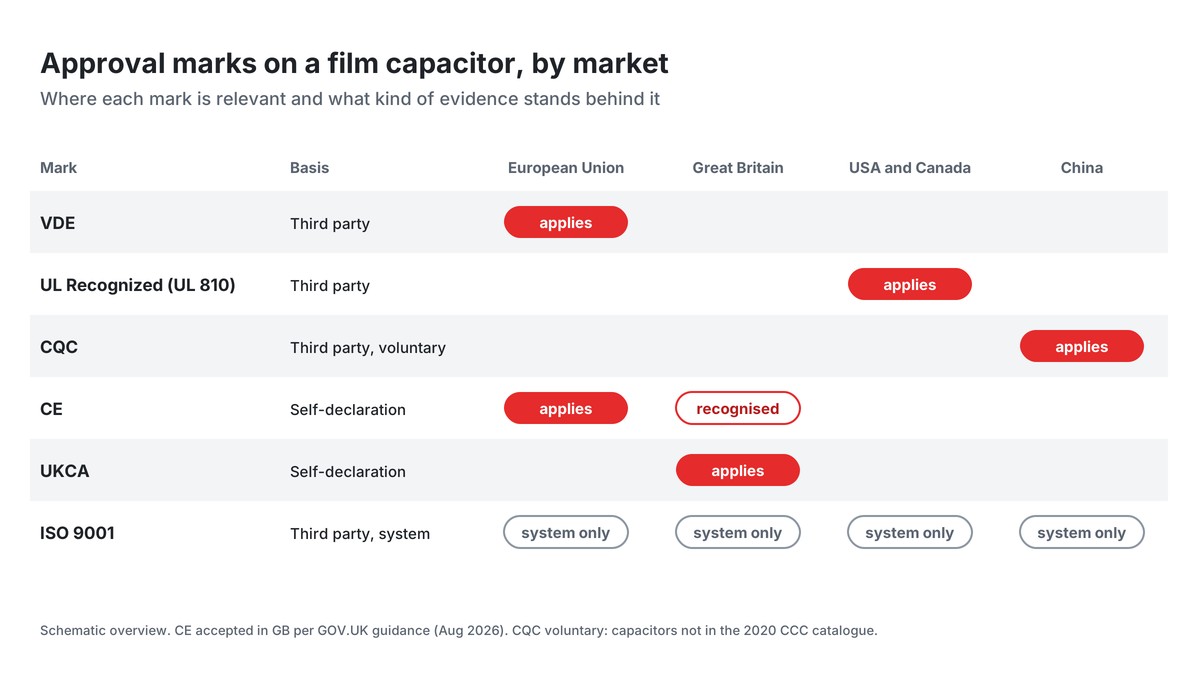
Buyers use approval marks as a sign of safety testing, and VDE notes that its certification marks "signify an important criterion for their buying decision". In February 2009, Health Canada published a consumer product recall of capacitors marked "CT" that bore a counterfeit UL Recognition Mark. Authorised versions had green cases, the counterfeits yellow ones, and the recall stated that the capacitors "have not been evaluated for safety" by UL. In May 2018, UL warned of a ground fault circuit interrupter bearing a counterfeit UL Mark and stated that these devices "have not been evaluated by UL to the appropriate Standards for Safety and it is unknown if they comply with any safety requirements." In Europe, VDE states that it prosecutes and publishes any unlawful use of its certification marks and keeps an online list of such cases.
A mark can be checked against the certifier's own database. UL lists Product iQ among its databases for searching UL-certified products, components and materials, and VDE offers a certificate search with or without the certificate number. An earlier article in this series explains how to read VDE, UL and CQC certificates in detail.
HYDRA's own warning
HYDRA's former website had a page on counterfeit products (hydra-components.com/counterfeit-products/), of which the Internet Archive holds a copy dated 22 August 2025. Doubtful HYDRA parts can be checked with HYDRA directly through the contact page.
Standards for counterfeit avoidance
A family of SAE Aerospace Standards, together with an inspection standard of the Independent Distributors of Electronics Association (IDEA), sets out how organisations should prevent, detect and handle counterfeit parts. AS5553E, for example, applies to organisations that procure and integrate EEE parts, including equipment manufacturers, contract manufacturers and maintenance organisations.
| Standard | Intended for | Focus |
|---|---|---|
| SAE AS5553E (2025) | Organisations that buy and integrate EEE parts | Risk-based avoidance, detection, mitigation, disposition |
| SAE AS6081A (2023) | Distributors | Reliable sources, risk assessment, control and reporting of suspect parts |
| SAE AS6171A (2018) | Users of parts with unknown chain of custody | Inspection and test procedures |
| SAE AS6496 (2014) | Authorised distributors | Counterfeit mitigation in authorised distribution |
| IDEA-STD-1010-B (2011) | Components bought and sold in the open market | Visual examination and acceptability criteria |
The standards combine purchasing discipline with inspection. AS6081A covers identifying reliable sources, assessing risk, controlling suspect parts and reporting them, and AS6171A standardises inspection and test procedures. ERAI states that comprehensive testing is essential for parts destined for high-risk applications, particularly for components lacking traceability to the original manufacturer and sourced from the open market.
Incoming inspection for film capacitors
For parts from an unfamiliar or open-market source, a five-step inspection from cheap to expensive is useful.
- Source and papers. Check that the supplier is authorised and that the certificate of conformity, lot code and packing list match the order. Ask the manufacturer to confirm unusual lot codes.
- Visual and marking. Compare with a golden sample from a trusted source: print quality, fonts, logos, terminals and the position of the approval marks. ERAI's glossary, citing SAE AS6081, describes a marking permanency test in which a swab with three parts mineral spirits and one part isopropyl alcohol is wiped across the marking, which should not smear or come off.
- Size and weight. Measure the dimensions and weigh parts against the reference.
- Electrical. Measure capacitance against the rated tolerance, dissipation factor (tan δ) and insulation resistance, and compare all three with the reference sample, not only with the datasheet.
- Internal. Open or X-ray a few samples. EN 60252-1 describes motor capacitors of classes S1 and S2 as fitted with an overpressure disconnect device, so a sample marked S1 or S2 should contain one.
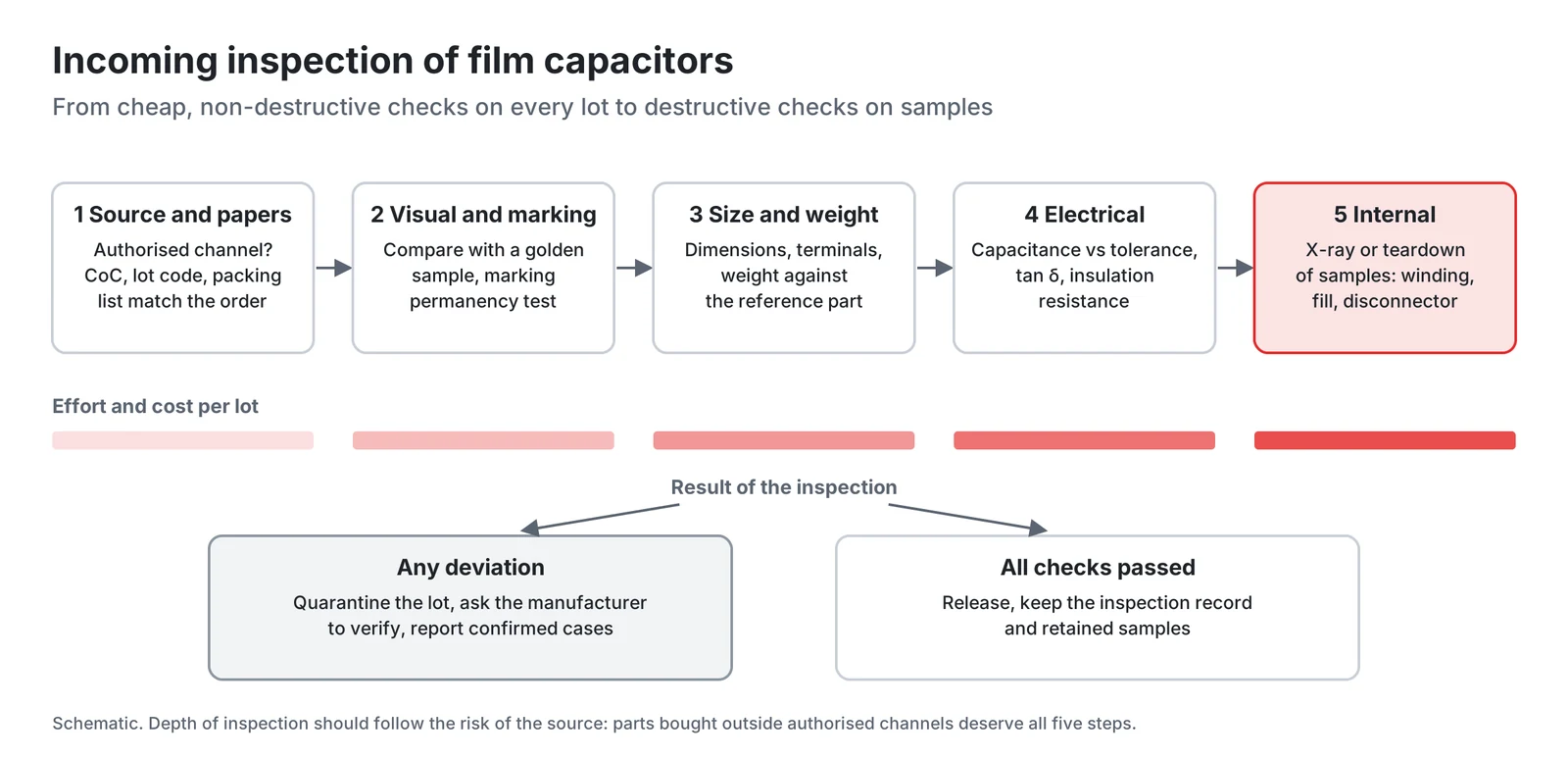
The ERAI finding that almost a quarter of tested suspect counterfeits passed electrical testing is the reason the steps should not be skipped. For motor capacitors, the failure protection of classes S1 to S3 is verified by a destruction test (EN 60252-1/A1, 5.16), not by measuring capacitance.
A checklist for HVAC technicians
Field replacement leaves no room for X-ray, but a few checks help:
- Capacitance and tolerance. The label should state both. For reference, the HYDRA capacitors catalogue 2025 gives +5 %/-0 % for its S2 oil-filled motor capacitors and ±5 % for the S0 resin-filled types. One HVAC service guide advises replacing a capacitor that measures outside ±10 % of its rating.
- Voltage and frequency. Use the same or a higher rated voltage, and check that the frequency marking covers the installation, for example 50/60 Hz.
- Safety class. A capacitor with an overpressure disconnect device is marked S1 or S2 under EN 60252-1/A1, which notes that S2 was formerly referred to as P2. S0 means no specific failure protection, and an unmarked part gives no assurance of protection.
- Approval marks and file number. Look up the UL file number or VDE certificate in the certifier's own database, and check that the holder is the brand on the label.
- Source and price. Buy through the manufacturer's distribution network.
Conclusion
Capacitors made up 3.74 % of the parts reported to ERAI in 2025, a small share that rose again after a period of decline. ERAI's data also show that active parts and brands new to its database are reported, not only obsolete parts. The capacitor cases cited here include parts not made to the correct specifications and parts with a counterfeit approval mark. HYDRA recommends buying through authorised channels, checking certificates in the issuers' databases, inspecting unfamiliar lots in stages and asking the manufacturer to verify doubtful parts. Electrical tests alone are not enough, because almost a quarter of tested suspect counterfeit parts passed them.
HYDRA motor capacitors and documents
HYDRA motor run capacitors are made in safety class S0 (resin-filled MKP type) and S2 (oil-filled MKP-Si type with an overpressure disconnector), according to the HYDRA capacitors catalogue 2025. Doubtful parts can be checked with HYDRA directly through the contact page, and the approvals can be verified against the certificates on the documents page.
| Series | Safety class | Rated voltage | Capacitance | Datasheet |
|---|---|---|---|---|
| 285 | S0 | 400 to 450 V AC | 0.8 to 30 µF | Series 285 (PDF) |
| 400 | S0 | 400 to 500 V AC | 0.8 to 40 µF | Series 400 (PDF) |
| 321 | S2 | 280 V AC | 1 to 100 µF | Series 321 (PDF) |
| 322 | S2 | 400 V AC | 2 to 20 µF | Series 322 (PDF) |
| 500 | S2 (marked P2 in the datasheet) | 400 to 500 V AC | 1 to 80 µF | Series 500 (PDF) |
Further documents:
- Contact HYDRA to verify a doubtful part or lot code
- HYDRA products and stock types
- HYDRA capacitors catalogue 2025 (PDF), with tolerances, approvals and general technical data
- Documents and certificates: VDE certificates, UL files, CQC, ISO 9001, RoHS and REACH
- UKCA declaration of conformity for motor capacitors (PDF)
References
- D. Akhoundov, 2025 Annual Report, ERAI, Inc., 2026. Text and charts "Part Types Reported in 2025 vs. Last 5 and 10 Year Periods" and "Reported Part Type Trends".
- ERAI, Glossary: Remarked Part, Recycled Part, Cloned Part, Marking Permanency Test.
- A. Shrivastava, M. Pecht, Counterfeit Capacitors in the Supply Chain, Journal of Materials Science: Materials in Electronics 25(2), pp. 645 to 652, February 2014. Abstract, CALCE, University of Maryland.
- Health Canada, Counterfeit UL Capacitors Type CTX, consumer product recall RA-500001949, 5 February 2009.
- UL, UL Warns of Counterfeit UL Marks on Ground Fault Circuit Interrupters (GFCI), Release 18PN-14, 31 May 2018. The page also lists Product iQ under UL databases.
- VDE Testing and Certification Institute, Unlawful use of the VDE mark.
- VDE Testing and Certification Institute, Certificate search.
- HYDRA a.s., counterfeit products page of the former website, archived copy of 22 August 2025, Internet Archive.
- ERAI, Counterfeit avoidance standards: titles, publication dates and scopes of AS5553E, AS6081A, AS6171A, AS6496 and IDEA-STD-1010-B.
- SAE International, AS5553E, Counterfeit Electrical, Electronic, and Electromechanical (EEE) Parts, Avoidance, Detection, Mitigation, and Disposition, 2025.
- HYDRA a.s., Hydra Capacitors catalogue 2025 (PDF), motor running capacitors.
- High Performance HVAC, Troubleshooting HVAC Capacitors, 2012, modified 2021.
- EN 60252-1:2011/A1:2013 (IEC 60252-1:2010/AMD1:2013), AC motor capacitors, Part 1, definitions 3.22.1 to 3.22.4 and 5.16.1. Free sample: SIST EN 60252-1:2011/A1:2014, iTeh Standards (PDF).
Products in this article
Standards, compliance & sourcing
Check stockAsk a HYDRA engineer
Send us your application data and our engineers will help you choose the right film capacitor. HYDRA has made film capacitors since 1899, with production in Jičín (Czech Republic) and Da Nang (Vietnam).
Ask an engineerCheck stock