The 2026 Capacitor Price Shock: MLCC and Tantalum Shortages and Where Film Capacitors Fit
In this article
For years, capacitors were the components a purchasing team worried about least. That changed in 2025 and 2026. Demand from AI servers has pulled multilayer ceramic (MLCC) and tantalum capacitors into a cycle of price increases and long-term supply agreements.
Designers now ask a fair question: can part of that exposure be moved to metallized polypropylene film capacitors? The honest answer is "in some functions, yes, and in others, not at all". This article summarises what has been reported about prices and lead times, sets out where film is a technically valid alternative and where it is not, and closes with a short checklist for supply-chain resilience.
Key takeaways
- Demand from AI servers has pulled multilayer ceramic (MLCC) and tantalum capacitors into a cycle of price increases and long-term supply agreements.
- Film capacitors cannot replace ceramics or tantalum in processor decoupling or compact low-voltage bulk, and claiming otherwise would mislead designers.
- Prices will continue to move for every technology, so resilience is built in the design and in the sourcing strategy, not in a price list.
What happened in 2025 and 2026
According to TrendForce, a single AI rack cabinet can use up to 440,000 high-end MLCCs, which the publisher puts at 8 to 10 times the consumption of a standard server. The same report notes that high-end MLCCs need dielectric layers thinner than 1 µm, and that the effective capacity per production line is only about one tenth of that for standard products. TrendForce also reports that one leading Korean MLCC maker had more than ten long-term agreement customers for AI MLCCs by late July 2026, and had disclosed two AI server MLCC agreements with deliveries locked through 2027.
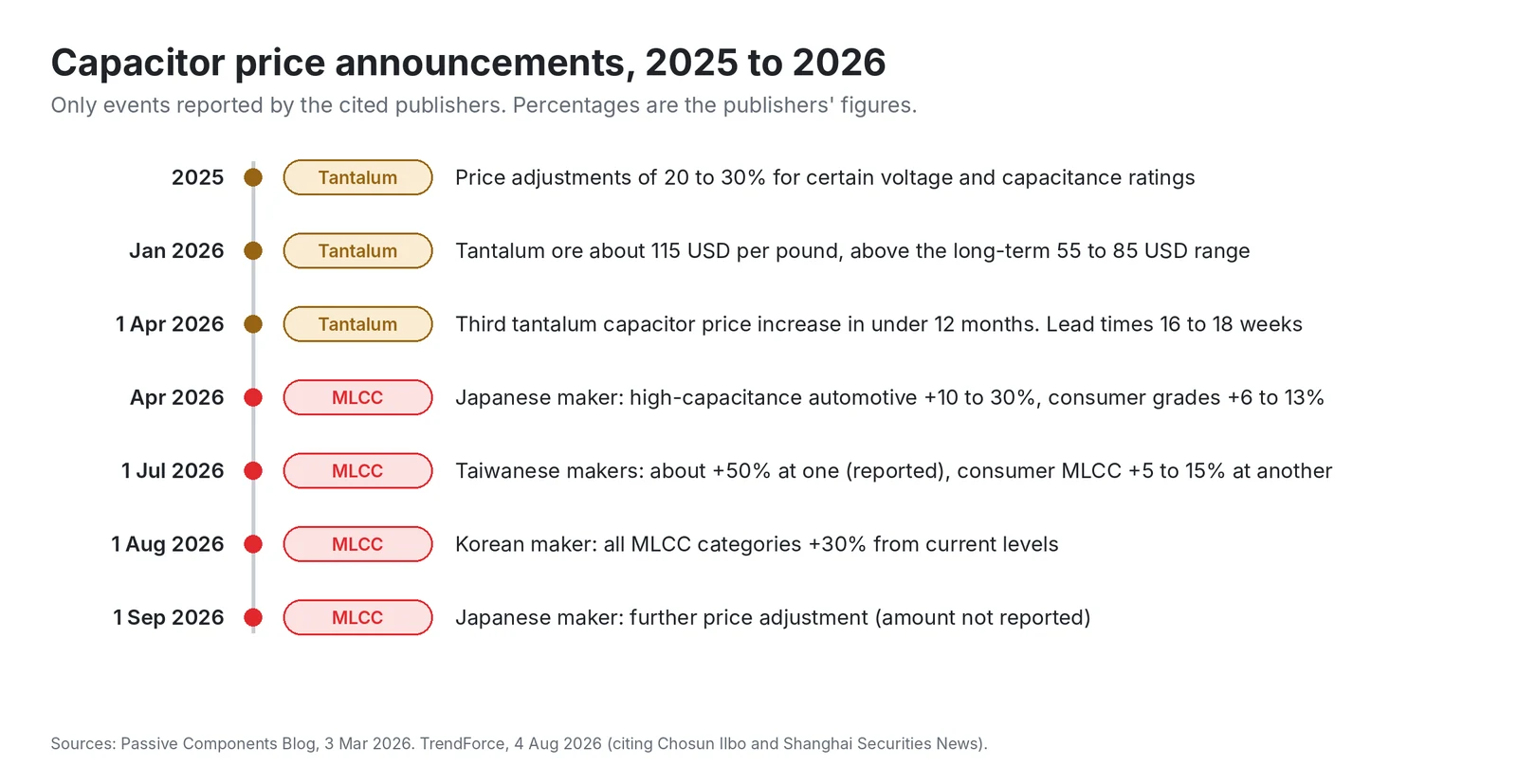
The price announcements followed. TrendForce reports that one Japanese MLCC maker raised prices of high-capacitance automotive MLCCs by 10 to 30% and consumer grades by 6 to 13% in April 2026, with a further adjustment from 1 September 2026, citing the cost of barium titanate powder, nickel powder and rare earth additives. One Taiwanese maker was reported to have raised prices by about 50% from 1 July 2026, with another Taiwanese maker raising consumer MLCC prices by 5 to 15% at the same time. A leading Korean maker raised all MLCC categories, from consumer to AI server grades, by 30% from 1 August 2026.
Tantalum moved in parallel. The Passive Components Blog reported in March 2026 that one major tantalum capacitor manufacturer would raise prices for the third time in less than 12 months, effective 1 April 2026, after 2025 adjustments of typically 20 to 30% for certain voltage and capacitance combinations. Tantalum concentrate was reported up more than 40% and tantalum metal in Europe around 60% over the same period, with ore at around 115 USD per pound, against a long-term range of 55 to 85 USD. Lead times were described as a manageable 16 to 18 weeks, well below the 35 to 43 week peaks of earlier shortages. The driver named is again AI servers, through polymer tantalum capacitors in power management.
Why film is not a drop-in substitute for MLCC
The first thing to say clearly: film capacitors do not replace MLCCs on a processor board. The physics explains why. The relative permittivity of polypropylene is 2.2, and Wang and Blaabjerg note that ceramics can have a much higher dielectric constant than film. NASA guidance on commercial MLCCs describes how volumetric efficiency is raised with dielectric layers down to the micrometre range, ceramics with greater dielectric constants and up to several hundred electrode plates. Decoupling next to a GPU or CPU needs a lot of capacitance at a few volts in a small area, and the AI server reports cited above name MLCCs and polymer tantalum capacitors for this role.
The comparison turns around at higher voltages and in AC duty. In high-value class II ceramic capacitors such as X7R, the NASA guidance states that capacitance and dissipation factor depend not only on temperature and frequency but also on the applied DC and AC voltage. As an illustration, if a class 2 part retained only 20% of its nominal value at the working voltage, the nominal capacitance would have to be five times the value the circuit needs:
Class II ceramics are piezoelectric. The NASA guidance warns of the microphonic effect and of acoustic resonances under pulse or AC voltage, and the Electronic Design overview of SiC inverters mentions audible noise at the switching frequency. Ceramic capacitors are also brittle, and soldering, board flexing and thermal expansion can crack them. Film capacitors are larger, but according to the same overview they offer low ESR and ESL, high ripple current capability and self-healing.
| Property | PP film | Class 2 MLCC |
|---|---|---|
| Relative permittivity | 2.2 | Much higher |
| Capacitance under DC voltage | Not cited as an issue | Depends on applied DC and AC voltage |
| Piezoelectric noise | Not cited as an issue | Microphonics, audible noise |
| Mechanical behaviour | Self-healing dielectric | Brittle, can crack |
| Size for given C and V | Larger | Very compact |
Where film is a valid technical alternative
With those properties in mind, the functions fall into three groups.
DC-link bulk in power stages. At several hundred volts and above, film is a mainstream choice. Wang and Blaabjerg describe metallized polypropylene film capacitors as well balanced for high voltage applications, for example above 500 V, in terms of cost and ESR. HYDRA's DC-link capacitors, for example, cover 700 to 1500 V DC in the datasheet. A recent analysis of DC-link capacitors for silicon carbide EV inverters recommends a hybrid of film capacitors with a cluster of ceramic capacitors, noting that the high cost of ceramics makes them uneconomical as the sole DC-link capacitance. The tantalum demand described above sits mainly in low-voltage segments such as 2.5 to 10 V. An earlier article in this series covered the sizing criteria for moving a DC link from electrolytic to film. The shift of AI data centres towards 800 V DC distribution, which NVIDIA expects in full-scale production from 2027, adds conversion stages at exactly the voltages where film is at home.
Snubbers, AC filters and PFC. These are AC or pulse duties. A Paumanok market overview lists snubber capacitors, DC-link capacitors and low voltage power factor correction among the established applications of power film capacitors, and power factor correction at mains frequency is a film domain.
X and Y interference suppression. IEC 60384-14 covers capacitors for electromagnetic interference suppression and connection to the supply mains, and its contents include an annex on capacitance ageing of class 2 ceramic capacitors. The same Paumanok overview lists interference suppression film capacitors as a film product group.
Where film is not an alternative: high-density decoupling on processor boards and compact low-voltage bulk capacitance. Wang and Blaabjerg note that biaxially oriented polypropylene is the preferred film for capacitors rated above about 250 V. Here the permittivity gap decides, and the realistic options remain MLCC, tantalum and aluminium electrolytic parts.
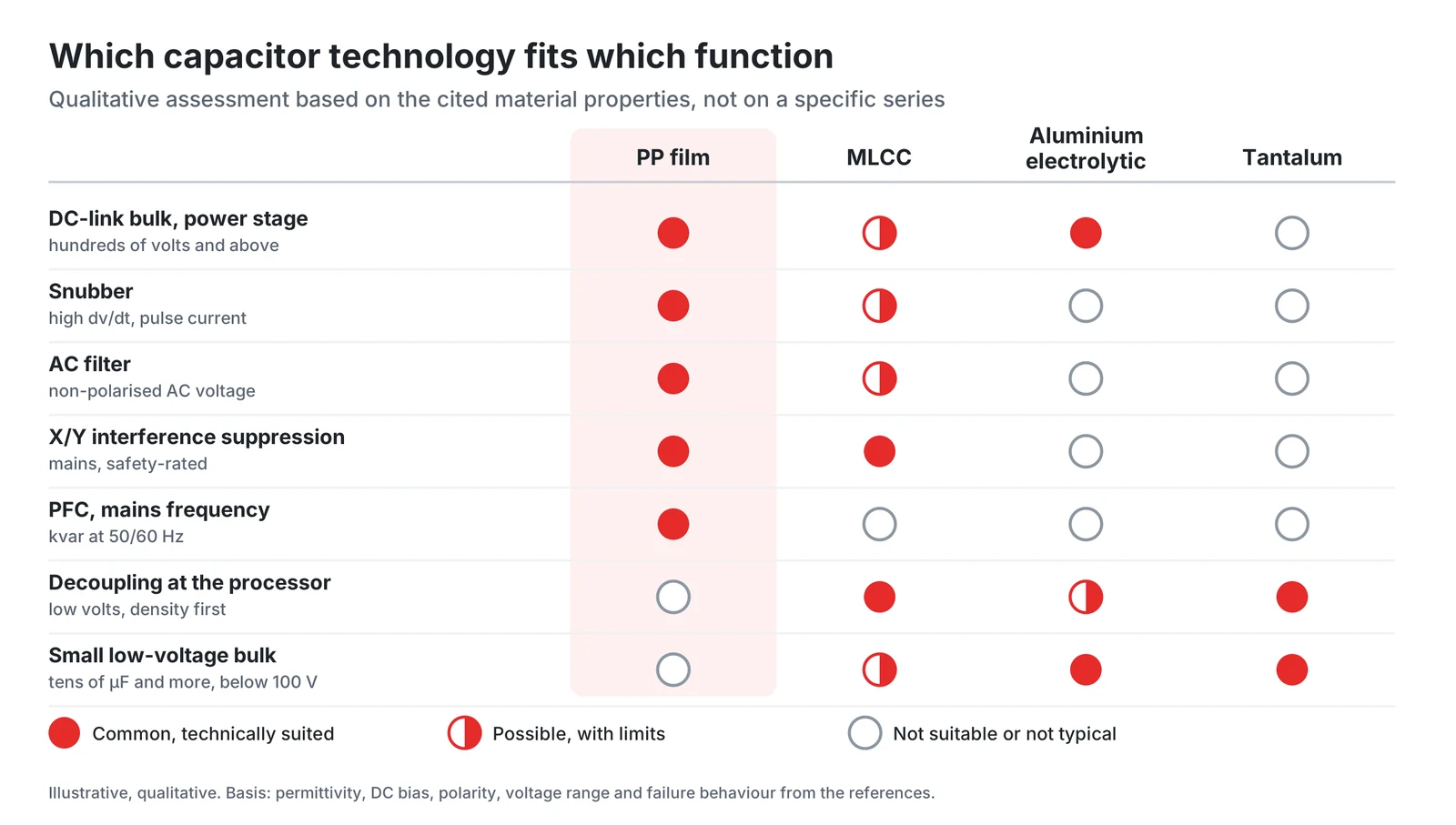
The practical conclusion is narrower than "replace ceramics with film". It is this: in power stages, filters and mains-connected functions, designs that drifted towards MLCC or electrolytic solutions for density or habit may be worth reviewing against film, both technically and from the supply side.
Supply-chain resilience
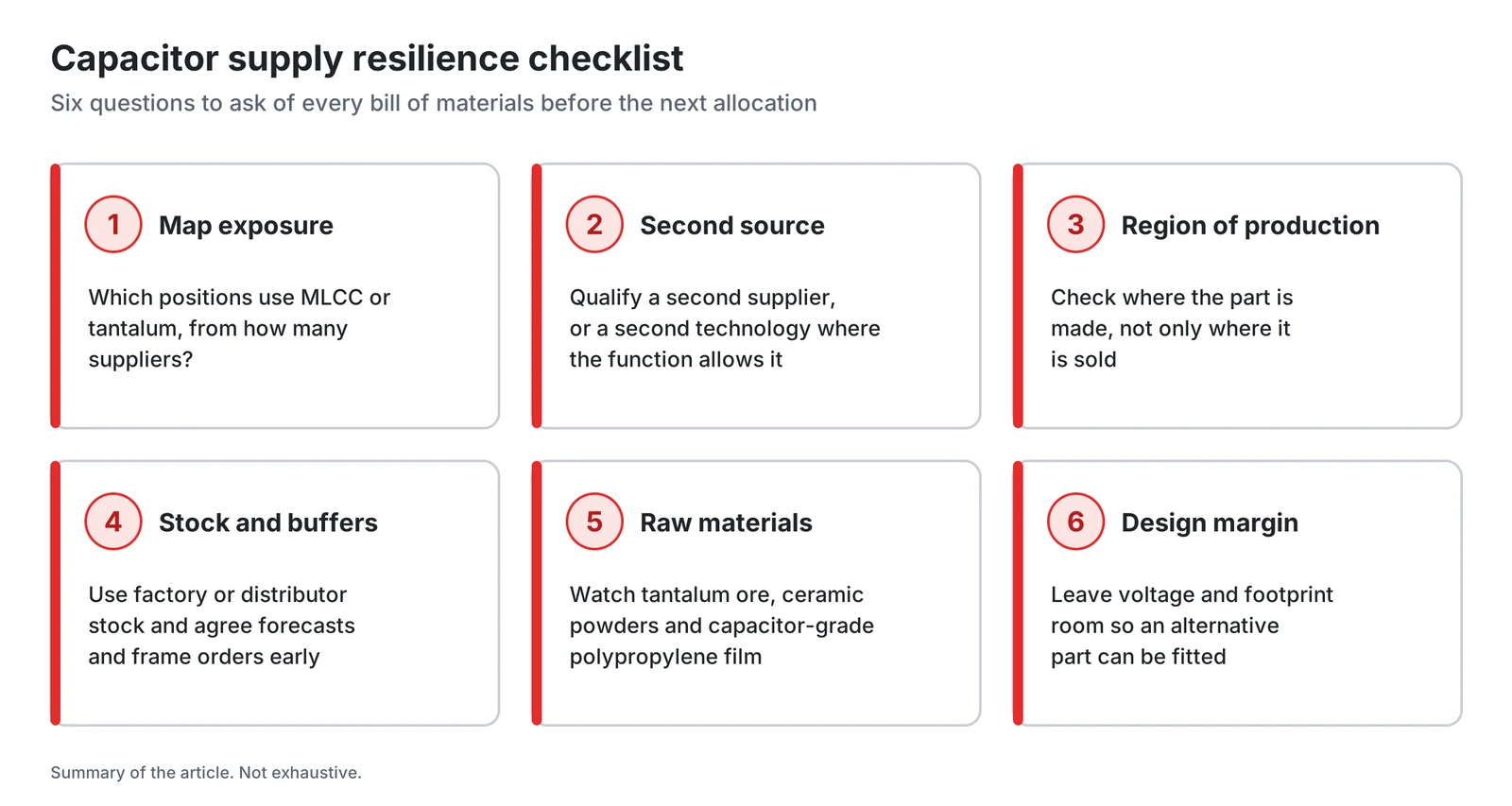
No capacitor technology is immune to price increases, film included. What a buyer can influence is exposure.
Dual sourcing works best at the level of function. A second qualified supplier for the same technology helps against a single factory problem. A second qualified technology helps against a whole market tightening, as long as the function allows it.
Regional production matters because allocation decisions are made where the capacity is. HYDRA, for example, produces in two plants: the headquarters and the first plant are in Jičín, Czech Republic, and the second plant in Da Nang, Vietnam, serves the Asia-Pacific region and high-volume orders for Europe.
Stock programmes shorten the response time when demand jumps. HYDRA publishes stock availability for its warehouses in Jičín and Da Nang. Other manufacturers and distributors run similar programmes, and forecasts and frame orders agreed early are usually worth more than spot buying later.
Raw materials deserve a line on the risk map. For tantalum it is the ore, for MLCCs the ceramic and nickel powders cited in the price announcements. For film capacitors it is capacitor-grade biaxially oriented polypropylene film.
Conclusion
The 2025 to 2026 price increases for MLCC and tantalum capacitors are driven by AI server demand, and long-term supply agreements running into 2027 suggest that the pressure will not disappear quickly. Film capacitors cannot replace ceramics or tantalum in processor decoupling or compact low-voltage bulk, and claiming otherwise would mislead designers. In DC-link bulk, snubbers, AC filters, PFC and interference suppression, however, film is an established choice, with self-healing, low ESR and ESL and high ripple current capability, while the voltage dependence and piezoelectric behaviour discussed above are documented for class II ceramics. Prices will continue to move for every technology, so resilience is built in the design and in the sourcing strategy, not in a price list.
HYDRA film capacitors and documents
HYDRA makes metallized polypropylene film capacitors in Jičín, Czech Republic, and Da Nang, Vietnam, for the power functions discussed above: DC link, AC filter, power factor correction and motor duty. The HYDRA catalogue 2025 lists the following series.
| Function | HYDRA series | Rated voltage |
|---|---|---|
| DC link | EGB DCL, EBB DCL | 700 to 1500 V DC (datasheet) |
| AC filter | EAB MKP, EBB MKP, ERB DPM, ECB DPM | 420 to 1400 V AC |
| Power factor correction | PAB DPM, PMB DPM, PRB DPMg, PRB DPM | 230 to 690 V AC |
| Motor run | MKP (S0), MKP-Si (S2) | 400 to 500 V AC |
Further documents:
- HYDRA capacitors catalogue 2025 (PDF)
- DC-link capacitors EGB DCL and EBB DCL datasheet (PDF)
- Stock types available from the warehouses in Jičín and Da Nang
- HYDRA products
- Documents and certificates: ISO 9001, RoHS, REACH and conflict minerals policy
- Contact for forecasts and frame orders
References
- TrendForce, Across-the-Board 30% Price Hike: MLCC Price Surge Intensifies, TrendForce News, 4 August 2026.
- T. Zedníček, AI Servers Demand is Driving Tantalum Capacitor Price Hikes, Passive Components Blog (EPCI), 3 March 2026.
- NVIDIA, NVIDIA 800 VDC Architecture Will Power the Next Generation of AI Factories, NVIDIA Technical Blog, 20 May 2025.
- A. Teverovsky, Guidelines for Selection, Screening and Qualification of Low-Voltage Commercial Multilayer Ceramic Capacitors for Space Programs, Rev. A, NASA NEPP, 2012 (PDF), introduction and guidelines 7 to 12.
- H. Wang, F. Blaabjerg, Reliability of Capacitors for DC-Link Applications in Power Electronic Converters: An Overview, IEEE Transactions on Industry Applications 50(5), 2014, section II and Fig. 3. Aalborg University repository.
- R. Gallay, Metallized Film Capacitor Lifetime Evaluation and Failure Mode Analysis, CERN-2015-003, p. 45, DOI 10.5170/CERN-2015-003.45. CERN Yellow Reports, CC BY 4.0.
- H. Ansell, Helix, Reevaluating DC-Link Capacitors for SiC Inverters, Electronic Design, 30 June 2026.
- D. Zogbi, Paumanok Publications, Film Capacitor Technologies and Applications 2024, passive-components.eu, 4 June 2024.
- IEC 60384-14:2023, Fixed capacitors for use in electronic equipment, Part 14: Sectional specification, Fixed capacitors for electromagnetic interference suppression and connection to the supply mains. IEC Webstore. Free preview with scope, contents and definitions.
- HYDRA a.s., company website, production sites and stock availability.
- HYDRA a.s., HYDRA capacitors catalogue 2025.
- HYDRA a.s., DC Link Capacitors EGB DCL/EBB DCL datasheet, edition 01/2019.
Products in this article
Standards, compliance & sourcing
Check stockAsk a HYDRA engineer
Send us your application data and our engineers will help you choose the right film capacitor. HYDRA has made film capacitors since 1899, with production in Jičín (Czech Republic) and Da Nang (Vietnam).
Ask an engineerCheck stock