Why Air-Conditioner Run Capacitors Fail, and How to Choose a Replacement
In this article
Replacing an air-conditioner run capacitor is a popular topic online. On 18 October 2026, a YouTube video titled "AC Not Working? DIY Capacitor Replacement Guide" had about 4.0 million views, "How To Check & Replace An Air Conditioner Capacitor" about 2.4 million and "How to Replace a Furnace or A/C Capacitor" about 1.2 million [1][2][3]. One HVAC trainer writes that the run capacitor is one of the most common parts to fail on a single-phase HVAC system, so much so that junior technicians are sometimes called "capacitor changers" [5].
This article is for service engineers who diagnose the failure and OEM engineers who specify the part. Thermal design and lifetime classes were covered in an earlier article in this series.
Key takeaways
- Behind the failure are heat, overvoltage, humidity, a wrong value or the end of life, when the capacitance drops below its tolerance.
- In a capacitor with an overpressure disconnector, the raised lid has a specific meaning.
- Replace an S2 part with an S2 part.
What a failing run capacitor looks like
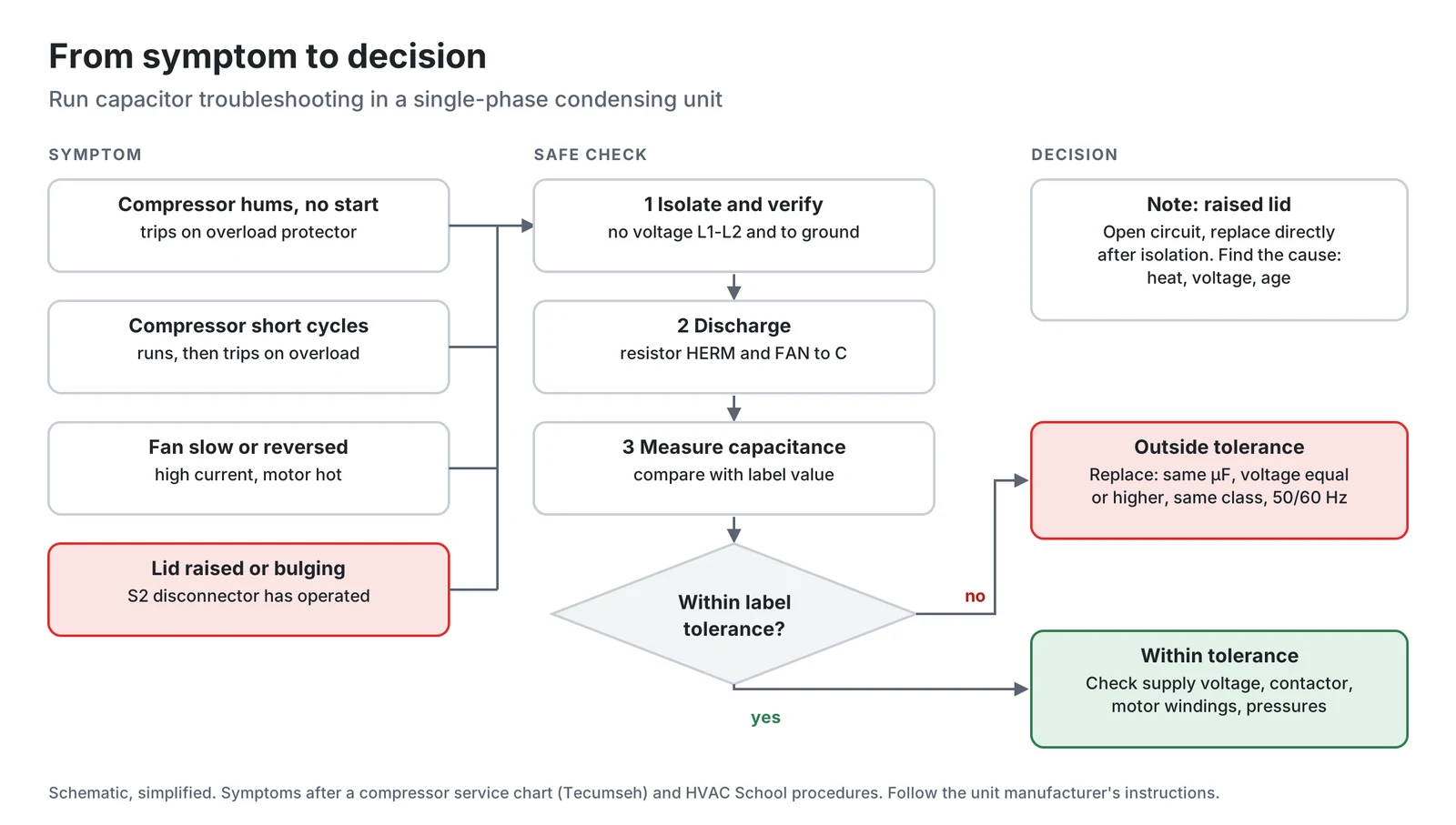
In a permanent split capacitor (PSC) motor, current flows through the start winding only by way of the run capacitor [5]. One trainer points out that a capacitor with zero capacitance is the same as an open start winding [5]. The typical field symptoms follow from that:
- Compressor hums but does not start, then trips on its overload protector. A compressor manufacturer's service chart lists a defective starting capacitor, low voltage, wiring errors and internal compressor faults as possible causes [8].
- Compressor starts and runs, but short cycles on the overload protector. The same chart lists a defective run capacitor next to low voltage, excessive discharge pressure and a faulty protector [8].
- Fan motor runs slowly, runs backwards, draws high current or overheats. These are the fan symptoms listed in one published replacement procedure [4].
- Raised or bulging lid, or oil leakage. Physical damage of this kind is a reason to replace the part, whereas normal surface rust is not [4].
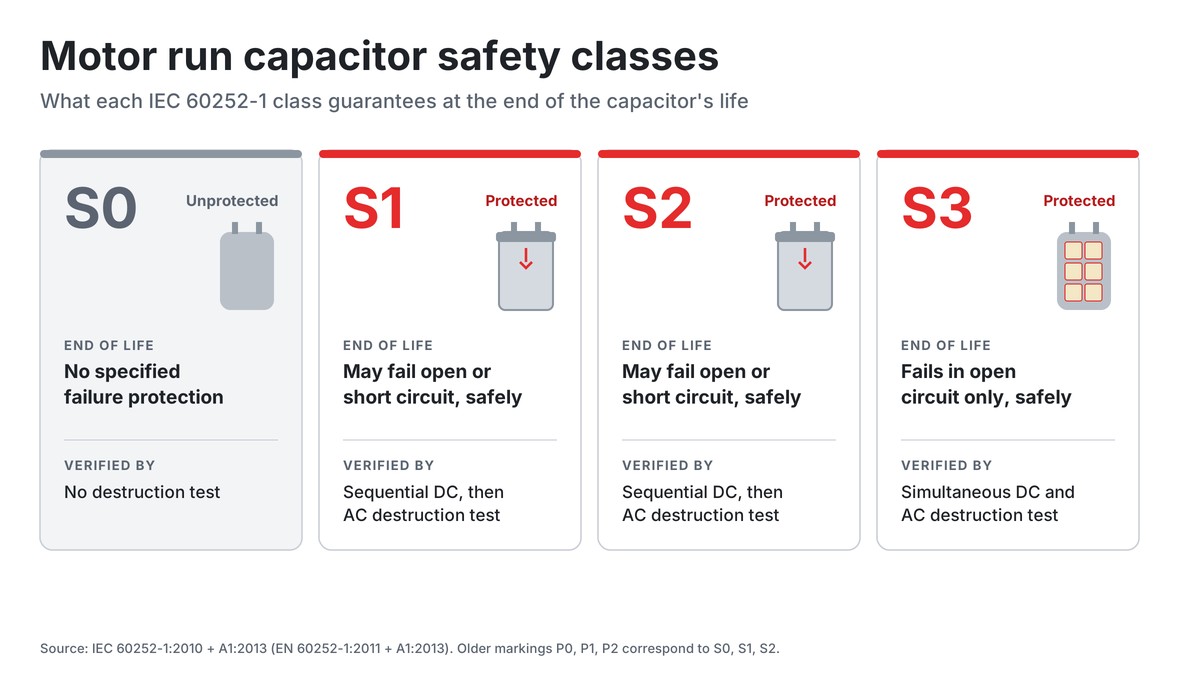
In a capacitor with an overpressure disconnector, the raised lid has a specific meaning. The HYDRA series 321 datasheet states that, in case of destruction, gas generation and a temperature rise increase the internal pressure, the can expands axially by up to about 9 mm, the thinner section of the internal fuse breaks, and the capacitor is disconnected safely from the mains [11]. A can expanded in this way therefore indicates that the disconnector has operated. The capacitor is disconnected and must be replaced, as described in the earlier article on safety classes.
Why run capacitors fail
A published replacement procedure names three causes of run capacitor failure: poor manufacturing quality, overtemperature and overvoltage [4]. A review of metallized film capacitor lifetime adds that most metallized film capacitors fail because the capacitance drops below the required tolerance, normally after the lifetime given by the manufacturer, and lists higher voltages, EMI, lightning, higher temperature and high humidity as causes on the application side [9].
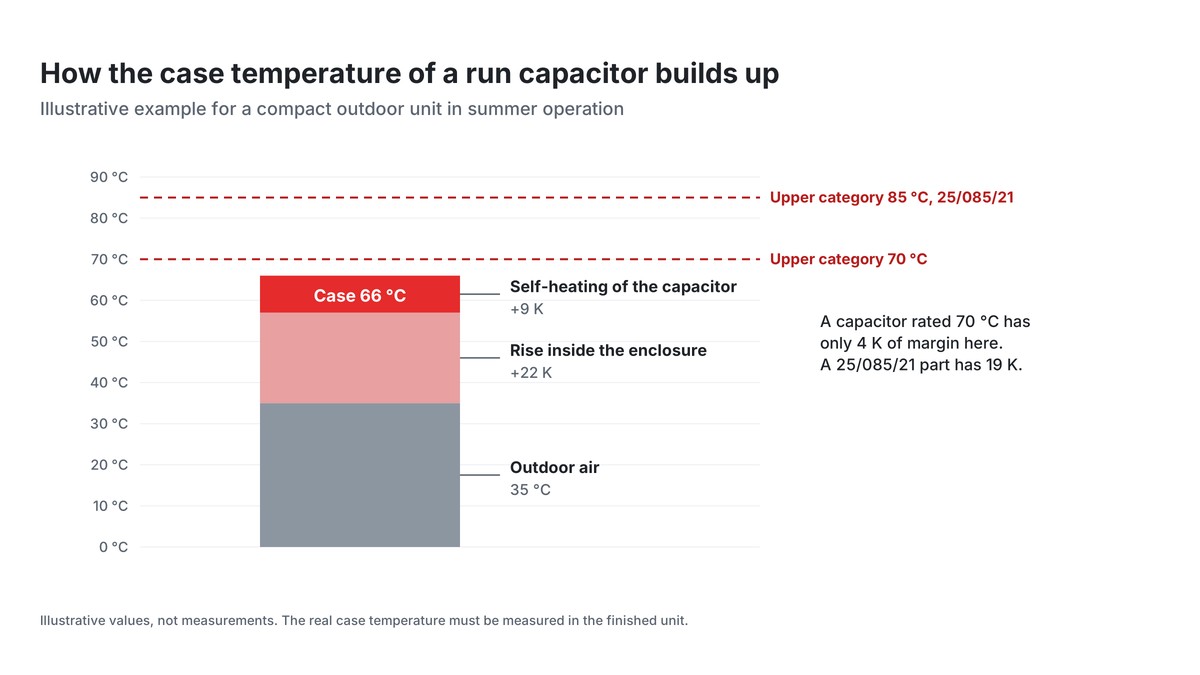
Heat. The speed of capacitance drop depends on the temperature, the voltage and the humidity, and a higher temperature accelerates the capacitance loss [9].
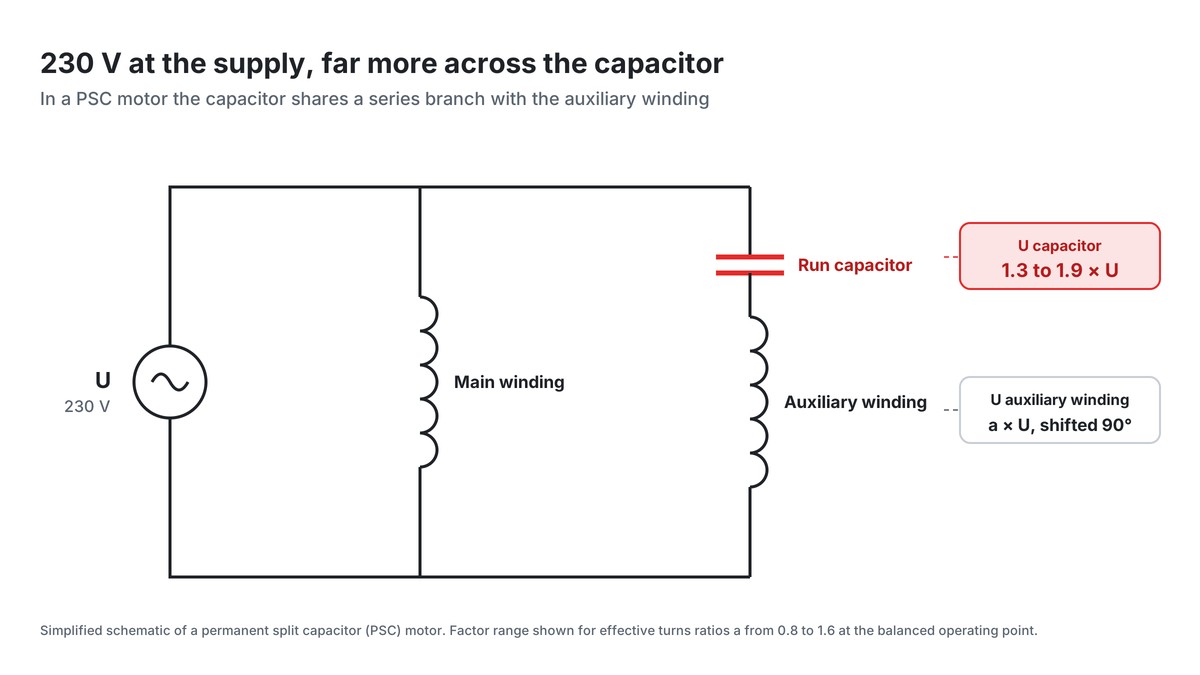
Overvoltage and surges. The voltage across a run capacitor is often higher than the line voltage, because of the back EMF of the motor, not because the capacitor raises it [5]. Gallay lists higher voltages, EMI and lightning among the application causes of failure [9].
Humidity. Plastic containers are never completely moisture tight, and moisture can corrode the thin metallized electrodes [9]. The same review describes corona discharges in the gas gaps between the films, which demetallize the electrode edges and cause a fast capacitance drop [9].
Wrong replacement value. A larger capacitance increases the current in the auxiliary winding, and one trainer warns that oversizing can quickly damage a compressor [5]. A compressor service chart lists an improper or incorrect run capacitor among the causes of failure [8].
End of life. In a self-healing event, the current near a breakdown evaporates the thin metallic layer around the defect. Most metallized film capacitors eventually fail because the capacitance drops below the required tolerance, normally after the expected lifetime given by the manufacturer [9].
Measuring the capacitor safely
Before touching the capacitor, the procedure cited above requires the disconnect to be removed and the absence of voltage to be checked L1 to L2 and each line to ground, with a meter tested on a known source. The capacitor is then discharged with a high-resistance resistor, bridging HERM and FAN to C on a dual part, or across a single capacitor [4]. The same source notes that a run capacitor rarely holds a charge on a working system, because it bleeds off through the motor windings, unless a winding is open [4].
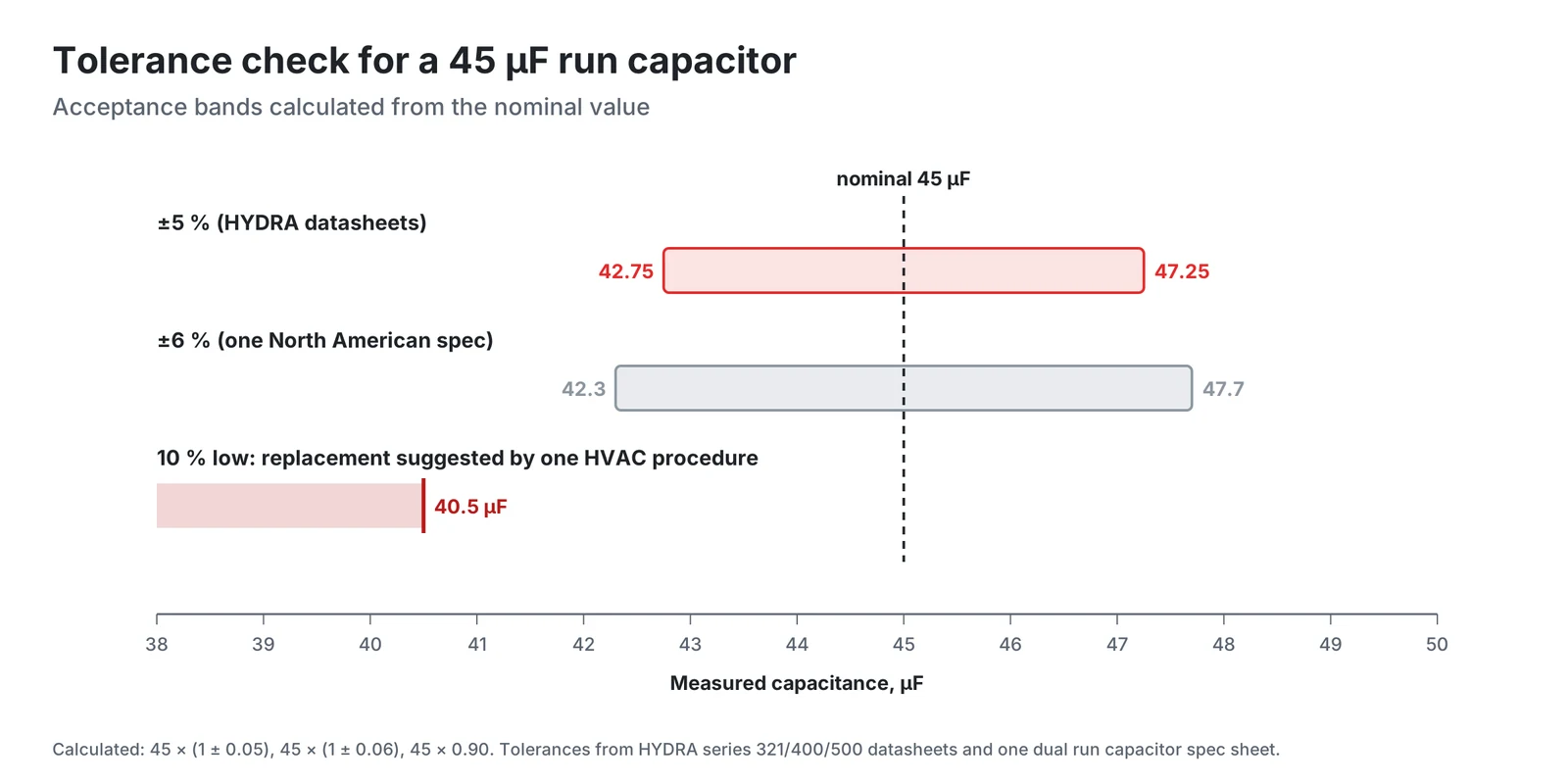
The bench test compares the meter reading with the label. HYDRA motor run capacitors of series 321, 400 and 500 are specified at ±5 % [10][11][12]. One trainer notes that most capacitors allow ±6 % [6]. A widely used procedure suggests replacement when the reading is more than 10 % low [4].
The capacitance can also be checked under load. The capacitive reactance gives C = I / (2πf × U), and in microfarads:
At 50 Hz the constant is 10⁶ / (2π × 50) = 3183. These are the factors used in the HVAC trade [5][6]. As an illustration, a 45 µF capacitor at 400 V and 60 Hz carries 2π × 60 × 45 × 10⁻⁶ × 400 = 6.8 A.
The dual run capacitor
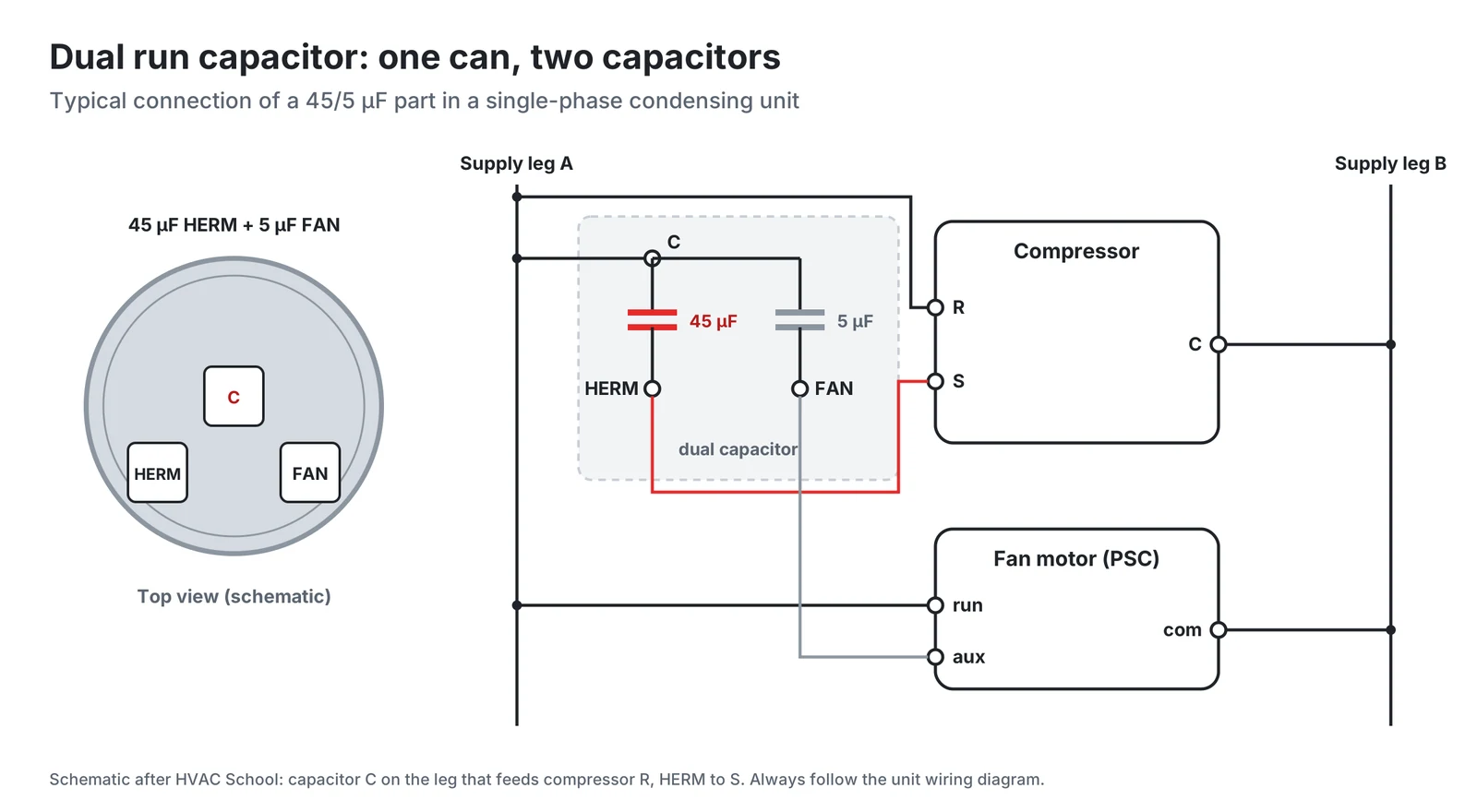
A dual run capacitor serves both the compressor and the outdoor fan of a condensing unit. It has three terminals: C, the common point between the two sections, HERM for the hermetic compressor and FAN for the fan [4][7].
The C terminal causes confusion. On the capacitor, C is the common point between the HERM and FAN sections. On the compressor, C is the common point of the run and start windings. The two are not connected together: the capacitor C terminal is fed from the same supply leg as the compressor R terminal, while compressor S goes to HERM [7]. The replacement procedure cited above requires a capacitor with the same MFD rating [4].
Choosing the replacement
- Same capacitance. Trade procedures require the same µF value [4]. A different value changes the auxiliary winding current [5].
- Equal or higher voltage rating. The rating is a not-to-exceed value, so a 440 V part may replace a 370 V part, but not the reverse [5]. In IEC-rated parts, rated voltage and class of operation belong together, as discussed in the earlier article on rated voltage.
- Same or better class of operation. The HYDRA series 500 datasheet shows how a single construction carries different classes at different voltages: class A at 420 V and class B at 470 V for 1 to 30 µF, and class D at 500 V for 1.5 to 30 µF [10].
- Same or better safety class. Replace an S2 part with an S2 part. HYDRA motor run capacitors are offered in S0 (resin-filled, plastic can) and S2 (vegetable oil, aluminium can with overpressure disconnector) versions [10][11][12][13].
- Approval marks. UL 810 is the UL standard for capacitors, current edition UL 810:2019, Ed. 6, with a revision dated 27 February 2025 that adds 50 Hz testing to the fault-current test (Figure 12.1) [14]. The HYDRA 2025 catalogue lists EN 60252-1/2 and UL 810 for its motor run capacitors [13], and the series 321 datasheet offers a UL rating of 250 V AC, 60 Hz, 10 000 AFC on request [11].
- 50/60 Hz rating. Capacitor current is proportional to frequency, so at 60 Hz the same capacitor at the same voltage carries 60 / 50 = 1.2 times the current it carries at 50 Hz. HYDRA series 321, 400 and 500 are rated for 50 Hz / 60 Hz [10][11][12].
- Mechanical fit and clearance. Case diameter, stud, terminals and mounting position must suit the bracket. One procedure recommends mounting upright with terminals up [4]. For S2 parts, HYDRA specifies a minimum clearance of about 12 mm between the terminal and neighbouring components, so that the disconnector can operate [11].
All HYDRA motor capacitors are routine tested 100 % in production, at 2.0 times the rated voltage between terminals and 3.6 kV between terminals and case for the S2 series 321 and 500 [10][11][13]. Counterfeit and substandard capacitors are the subject of a separate article in this series.
Conclusion
A failed run capacitor shows itself through a humming compressor, short cycling, a slow fan or a raised lid, and on a part with an overpressure disconnector a can expanded in this way means the disconnector has operated. Behind the failure are heat, overvoltage, humidity, a wrong value or the end of life, when the capacitance drops below its tolerance. Isolate, verify and discharge before handling, compare the reading with the label tolerance, and replace with the same µF, an equal or higher voltage, the same or better class of operation and safety class, the right approvals, a 50/60 Hz rating and a mechanical fit that leaves room for the disconnector.
This article gives general guidance. The final selection should always be confirmed with the equipment manufacturer's data and the capacitor manufacturer's datasheets.
HYDRA motor run capacitors and documents
HYDRA motor run capacitors are made in safety classes S0 and S2. The S2 series carry an overpressure disconnector, and their datasheets state the room it needs: for series 321, 322 and 500 the can may extend axially by up to about 9 mm, and a clearance of about 12 mm from the terminal to neighbouring components is required. The 2013 datasheets use the earlier markings P0 and P2, which correspond to S0 and S2.
| Series | Safety class | Rated voltage | Capacitance | Datasheet |
|---|---|---|---|---|
| 285 | S0 | 400 to 450 V AC | 0.8 to 30 µF | Series 285 (PDF) |
| 400 | S0 | 400 to 500 V AC | 0.8 to 40 µF | Series 400 (PDF) |
| 321 | S2 | 280 V AC | 1 to 100 µF | Series 321 (PDF) |
| 322 | S2 | 400 V AC | 2 to 20 µF | Series 322 (PDF) |
| 500 | S2 | 400 to 500 V AC | 1 to 80 µF | Series 500 (PDF) |
Further documents:
- HYDRA capacitors catalogue 2025 (PDF), with the current MKP (S0) and MKP-SI (S2) ranges and approvals
- Series 330 start capacitors (PDF)
- Product overview and stock types
- Documents and certificates: VDE certificates, ISO 9001, RoHS and REACH
- UKCA declaration of conformity for motor capacitors (PDF)
References
- R. Lloyd, AC Not Working? DIY Capacitor Replacement Guide, YouTube (3 978 869 views on 18 October 2026 according to the Return YouTube Dislike API).
- The DIY HVAC Guy, How To Check & Replace An Air Conditioner Capacitor, YouTube (2 367 827 views on 18 October 2026, same source).
- Word of Advice TV, How to Replace a Furnace or A/C Capacitor, YouTube (1 174 012 views on 18 October 2026, same source).
- B. Orr, Capacitor Testing and Replacement Procedure, HVAC School, 20 March 2024.
- B. Orr, 5 Capacitor Facts You Should Know, ACHR News, 10 June 2019 (also HVAC School, 7 June 2025).
- HVAC School, Testing Run Capacitors the Smart (and Easy) Way, 4 March 2017.
- HVAC School, C Stands for "Common Mistake", 27 May 2025.
- Tecumseh Products, Trouble Shooting and Service Chart, in Electrical Service Parts Troubleshooting Guide.
- R. Gallay, Metallized Film Capacitor Lifetime Evaluation and Failure Mode Analysis, CERN Yellow Reports CERN-2015-003, DOI 10.5170/CERN-2015-003.45, arXiv:1607.01540.
- HYDRA a.s., Hydra Motor Capacitors for AC Motors, MKP-Si technology series 500, safety class S2 (marked P2), datasheet ed. 02/13.
- HYDRA a.s., Hydra Motor Capacitors for AC Motors, MKP-Si technology series 321, safety class S2 (marked P2), datasheet ed. 02/13.
- HYDRA a.s., Hydra Motor Capacitors for AC Motors, MKP technology series 400, safety class S0 (marked P0), datasheet ed. 02/13.
- HYDRA a.s., Hydra Capacitors catalogue 2025, Motor Running Capacitors.
- UL 810, Capacitors, edition 6 (29 October 2019, last revision 27 February 2025), UL Standards & Engagement, product page with scope and summary of topics. Revision summarised in Intertek, Standards Update Notice UL 810, 7 August 2025 (clause 12 Fault-Current Test, Figure 12.1).

Ask a HYDRA engineer
Send us your application data and our engineers will help you choose the right film capacitor. HYDRA has made film capacitors since 1899, with production in Jičín (Czech Republic) and Da Nang (Vietnam).
Ask an engineerCheck stock