Motor Capacitors in Heat Pumps and HVAC: Hot Spot, Duty Cycle and Life Class
In this article
Heat pumps and air conditioners use motor run capacitors in their fan and compressor motors. Such a capacitor stays in circuit for as long as its motor runs, and its ageing depends on temperature, voltage and humidity. Chosen from the voltage and capacitance alone, it may not last as long as the appliance.
This article explains the three numbers that decide whether a run capacitor survives in HVAC equipment: the temperature of its case, the number of operating hours it collects per year, and the class of operation it is rated for.
Key takeaways
- In heat pumps and air conditioners the life of a run capacitor is set by its temperature, its voltage and the hours it runs.
- The case temperature in the finished unit, the operating hours per year and the class of operation together show whether the capacitor can last as long as the appliance.
- Measure the temperature where the capacitor actually sits, translate the duty cycle into hours, and add temperature or voltage margin when the required hours exceed the class life.
Where run capacitors still sit in HVAC equipment
Many fan motors in heating and cooling equipment are permanent split capacitor (PSC) motors. The Building America Solution Center, a U.S. Department of Energy resource operated by Pacific Northwest National Laboratory, states that "until recently PSC motors have been the most popular fan motor for furnaces, air handlers, condensing units, and packaged units". It also describes replacement electronically commutated motors (ECMs) that can be installed in place of PSC motors in existing equipment.
The same resource names the capacitor as one of the three typical failure points of a PSC motor, together with the bearings and the windings. The applications HYDRA lists for its motor run capacitors include:
- compressors and fans,
- pumps and blowers,
- refrigerators, dishwashers and dryers.
IEC 60252-1 describes a motor running capacitor as one that is usually connected permanently to the motor winding and remains in circuit throughout the running period of the motor (definition 3.1, note). Its life is therefore counted in the operating hours of the motor, not in calendar years.
Ambient temperature is not capacitor temperature
The temperature limits of a motor capacitor are written in its climatic category, which IEC 60068-1 covers in Clause 7 and Annex A, Component climatic category. HYDRA motor capacitor datasheets mark the category 25/85/21 according to IEC 60068 and explain the three numbers as minimum temperature, maximum temperature and damp-heat severity. A 25/85/21 part is therefore rated for -25 °C to +85 °C. IEC 60252-1 has its own guidance subclause on checking capacitor temperature (9.3), covering the choice of the maximum and the minimum permissible capacitor operating temperature.
In an HVAC unit the case temperature is built up in three steps:
- Outdoor or room air. The design value for the climate where the unit will be installed, including summer peaks for cooling and the hours of operation in hot weather.
- Rise inside the enclosure. Heat sources inside the enclosure warm the air around the capacitor above the outside or room air.
- Self-heating of the capacitor. Current through the capacitor heats it. Gallay names high currents, which increase the capacitor temperature, as one of the main failure modes of metallized film capacitors.
The result should therefore be measured: a thermocouple on the case of the capacitor, in the finished unit, at the highest ambient temperature and the highest load the unit is specified for, with the enclosure closed.

The measured value matters because film capacitor ageing depends on temperature. R. Gallay, in the CERN accelerator school proceedings, models capacitor ageing versus temperature with an Arrhenius law and uses a ratio Ea/kB = 7000 K, which he describes as a fit to temperature factors published by capacitor manufacturers. With these parameters he gives an acceleration factor of 7.1 between 40 °C and 70 °C. Applied around 85 °C, the same formula gives a life reduction of roughly 1.8 times for every 10 K. In this model, a capacitor rated 25/85/21 that runs at a case temperature of 70 °C rather than 85 °C has about 2.3 times the life. A part with an upper category temperature of 70 °C would be outside its rated range at 80 °C.

Duty cycle and the class of operation
IEC 60252-1 defines classes of operation in definition 3.9. Its current edition clarified that definition with the concept of "probable life" with reference to statistics. HYDRA datasheets state the life of each class as follows:
| Class | Life (HYDRA datasheets) |
|---|---|
| A | 30 000 h |
| B | 10 000 h |
| C | 3 000 h |
| D | 1 000 h |
HYDRA datasheets state a failure rate of ≤ 3 % for these life classes. They also give several ratings for one series. Series 400, for example, is rated class A at 400 V, class B at 460 V and class C at 500 V, which shows how voltage and life are traded against each other.
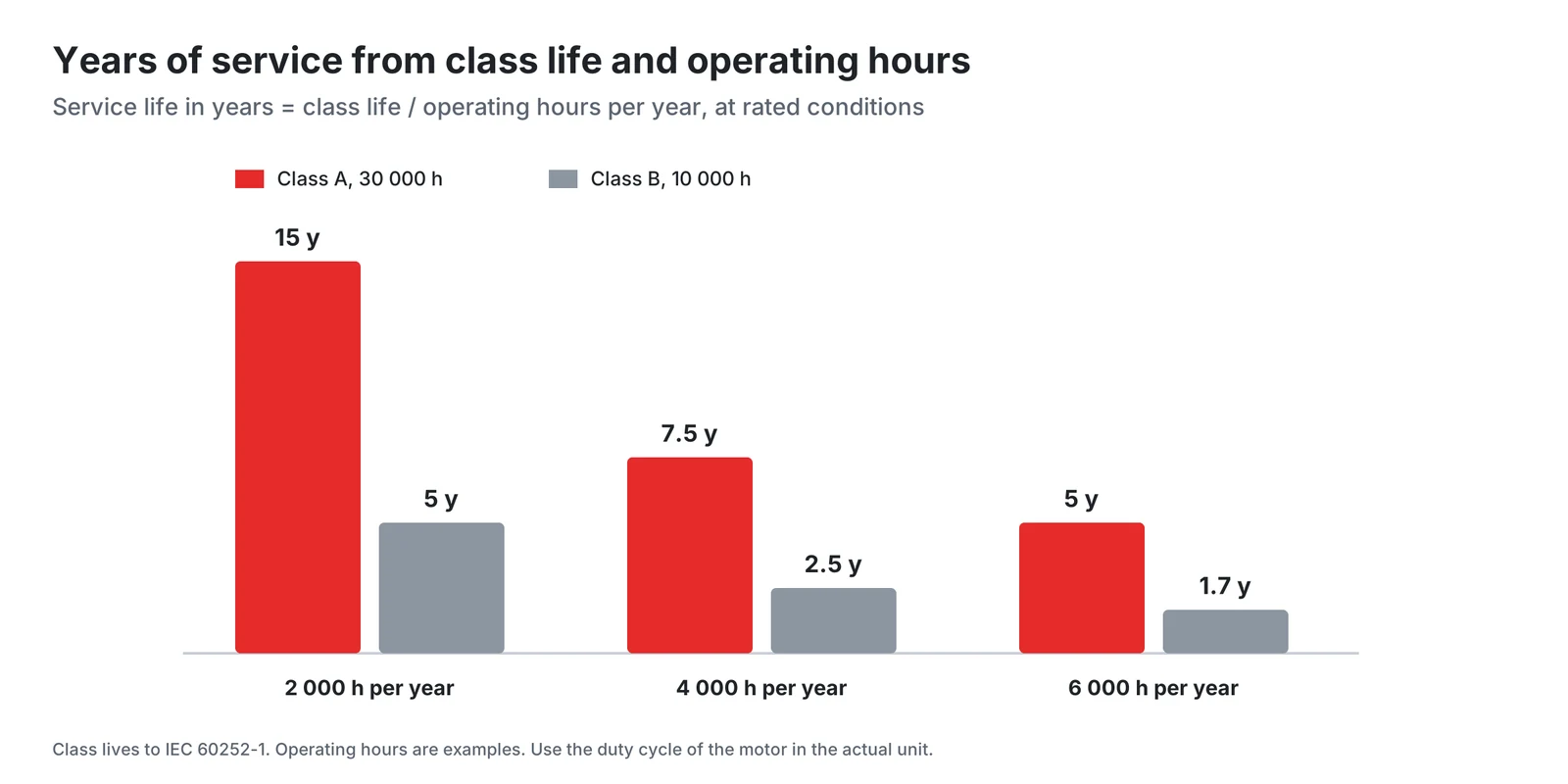
The number of hours a capacitor collects per year depends on the application, because it accumulates hours whenever its motor runs. Service life in years equals the class life divided by the operating hours per year.
| Operating hours per year | Class A, 30 000 h | Class B, 10 000 h |
|---|---|---|
| 2 000 h | 15 years | 5 years |
| 4 000 h | 7.5 years | 2.5 years |
| 6 000 h | 5 years | 1.7 years |
The table assumes that the capacitor operates at its rated conditions. In Gallay's model, life grows at lower temperature and lower voltage and shrinks above the reference values. As an example, a fan motor that runs 4 000 h per year for ten years needs 40 000 h, more than class A (30 000 h) provides at rated conditions. Such a design needs class A together with a temperature or voltage margin.
Voltage and frequency complete the picture
Temperature and hours are not the only stresses. IEC 60252-1 gives guidance on the choice of rated voltage, including measurement of the working voltage and the influence of capacitance (9.2.1 and 9.2.2), and states in 6.1 that "operation above the rated voltage will reduce the life expectancy of the capacitor". To illustrate voltage ageing, Gallay sets the exponent of an inverse power law to 3.5. With that value, a capacitor operating permanently 10 % above its reference voltage would keep only about 72 % of its life. Gallay combines the temperature, voltage and humidity factors by multiplication, so the reductions multiply.
Frequency should be checked too. HYDRA motor run capacitors are marked 50 Hz / 60 Hz, and for units destined for 60 Hz markets the capacitor temperature should also be verified at 60 Hz.
Selection checklist for HVAC and heat pump capacitors
- Measure the case temperature in the finished unit at the highest specified ambient and load, with the enclosure closed.
- Choose a climatic category whose upper temperature exceeds the measured case temperature with margin, for example 25/85/21.
- Estimate the operating hours per year from the duty cycle of the motor, not of the appliance as a whole.
- Divide the class life by those hours and compare the result with the expected service life of the unit.
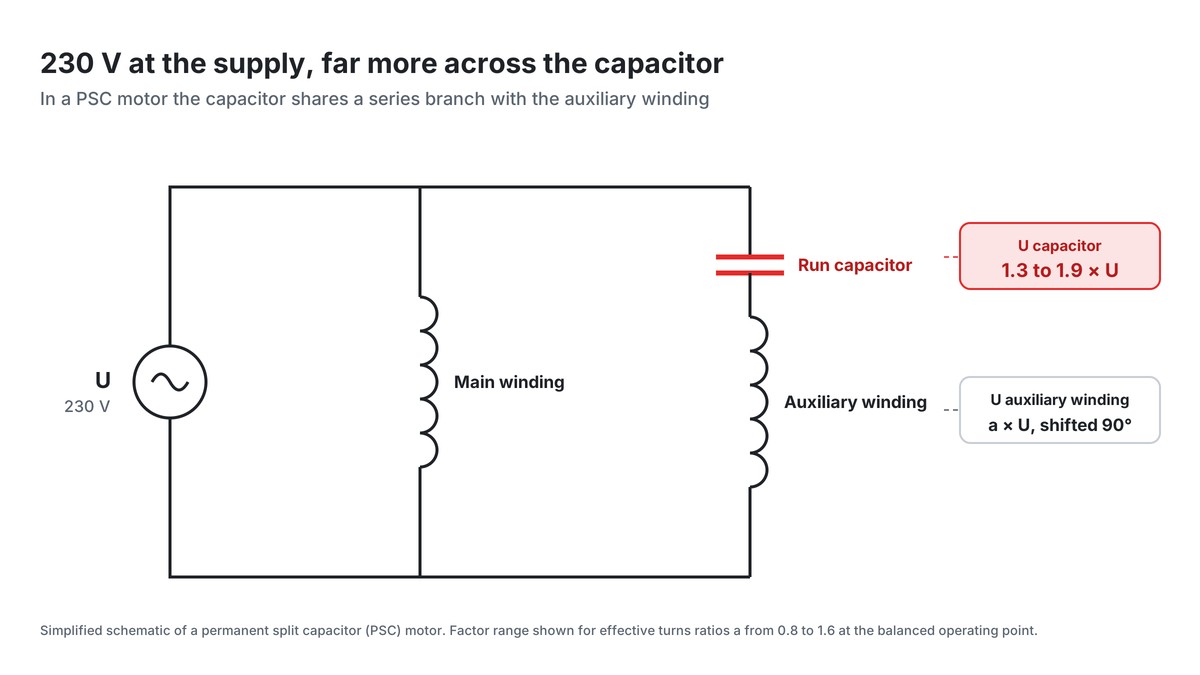
- Check the voltage across the capacitor in operation, not only the mains voltage, and use the voltage ratings of the datasheet to see how much life the voltage costs.
- Verify capacitor temperature and current at 60 Hz for units destined for 60 Hz markets.
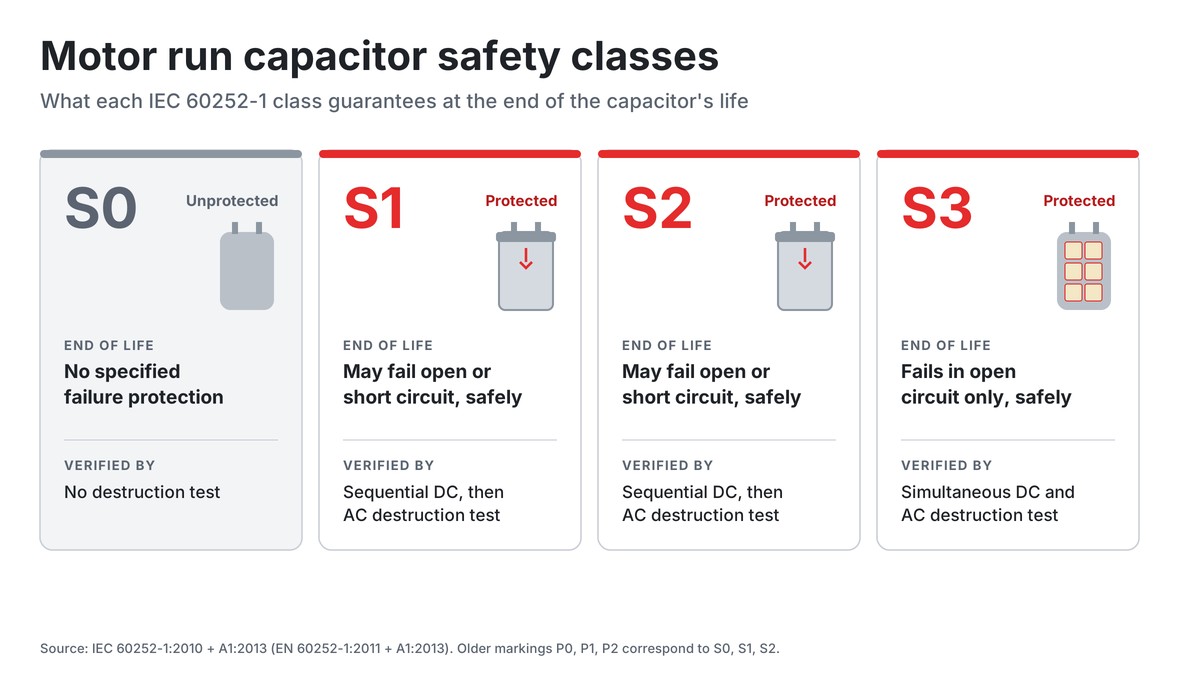
- Select the safety class that the end-product standard and the customer require. Where a protected capacitor is needed, choose class S2 with an overpressure disconnector or class S3 with segmented film.
Conclusion
In heat pumps and air conditioners the life of a run capacitor is set by its temperature, its voltage and the hours it runs. The case temperature in the finished unit, the operating hours per year and the class of operation together show whether the capacitor can last as long as the appliance. Measure the temperature where the capacitor actually sits, translate the duty cycle into hours, and add temperature or voltage margin when the required hours exceed the class life.
HYDRA motor run capacitors and documents
All HYDRA motor run capacitor series listed below are rated for 50 Hz and 60 Hz and carry the climatic category 25/85/21 to IEC 60068. Each datasheet states the class of operation together with the rated voltage and capacitance range, and HYDRA specifies a failure rate of up to 3 % for its life classes.
| Series | Safety class | Class of operation (datasheet) | Datasheet |
|---|---|---|---|
| 285 | S0 | B (10 000 h) at 400 V, C (3 000 h) at 450 V | Series 285 (PDF) |
| 400 | S0 | A (30 000 h) at 400 V, B (10 000 h) at 460 V | Series 400 (PDF) |
| 321 | S2 | B (10 000 h) at 280 V | Series 321 (PDF) |
| 322 | S2 | B (10 000 h) at 400 V | Series 322 (PDF) |
| 500 | S2 | A (30 000 h) at 420 V, B (10 000 h) at 470 V, 1 to 30 µF | Series 500 (PDF) |
Further documents:
- HYDRA products, including motor run and start capacitors
- Stock types
- HYDRA capacitors catalogue 2025 (PDF), with life classes, approvals and general technical data
- UKCA declaration of conformity for motor capacitors (PDF)
- Documents and certificates: VDE certificates, ISO 9001, RoHS and REACH
References
- IEC 60252-1:2010+AMD1:2013 CSV, AC motor capacitors, Part 1: General, Performance, testing and rating, Safety requirements, Guidance for installation and operation, edition 2.1. Free IEC preview with the foreword (changes in 3.9 and 6.1), the table of contents (6.1, 9.2, 9.3) and definition 3.1.
- IEC 60252-1:2010/AMD1:2013 (EN 60252-1:2011/A1:2013), definition 3.22 and subclause 5.16.1. Free sample of SIST EN 60252-1:2011/A1:2014.
- IEC 60068-1:2013, Environmental testing, Part 1: General and guidance, edition 7.0. Free IEC preview with the table of contents (Clause 7 and Annex A, Component climatic category).
- R. Gallay, Metallized Film Capacitor Lifetime Evaluation and Failure Mode Analysis, CERN Yellow Reports CERN-2015-003, CAS-CERN Accelerator School: Power Converters, p. 45, CC BY 4.0. Free PDF (arXiv), sections 3, 4.1, 4.2 and 4.4.
- Building America Solution Center (U.S. Department of Energy, Pacific Northwest National Laboratory), ECM Air Handler Fans, last updated 2022-10-07.
- HYDRA a.s., motor run capacitor datasheets series 285, 400, 321, 322 and 500 (linked in the table above) and HYDRA capacitors catalogue 2025 (PDF).

Ask a HYDRA engineer
Send us your application data and our engineers will help you choose the right film capacitor. HYDRA has made film capacitors since 1899, with production in Jičín (Czech Republic) and Da Nang (Vietnam).
Ask an engineerCheck stock