From Resin to Roll: The Capacitor-Grade Polypropylene Film Supply Chain
In this article
- Step 1: a resin that is cleaner than packaging grades
- Step 2: casting and biaxial stretching
- Step 3: metallization
- Steps 4 and 5: winding and end spray
- A concentrated supply base
- Capacity is growing, driven by electric vehicles
- Why thinner film matters, and why it is hard
- What to ask your capacitor supplier
- Conclusion
- HYDRA film capacitors and documents
- References
A metallized polypropylene capacitor is, in material terms, mostly film. The winding, the end spray and the housing matter, but the dielectric that carries the voltage is a polypropylene film only micrometres thick, with an evaporated metal electrode of the order of 100 nm on its surface.
Buyers of film capacitors rarely see this part of the chain. This article follows the material from the polymer plant to the finished capacitor, shows where the supply is concentrated, summarises the capacity expansions announced in recent years and ends with the questions a purchasing or quality engineer can reasonably ask a capacitor supplier about film origin and change control.
Key takeaways
- A metallized polypropylene capacitor is, in material terms, mostly film.
- Film producers have announced capacity expansions driven by electric vehicles, yet a 2021 report described the ultra-thin film market for these vehicles as dominated by one producer.
- For buyers, the practical response is to ask where the film comes from, how a second source is qualified and how changes are notified.
Step 1: a resin that is cleaner than packaging grades
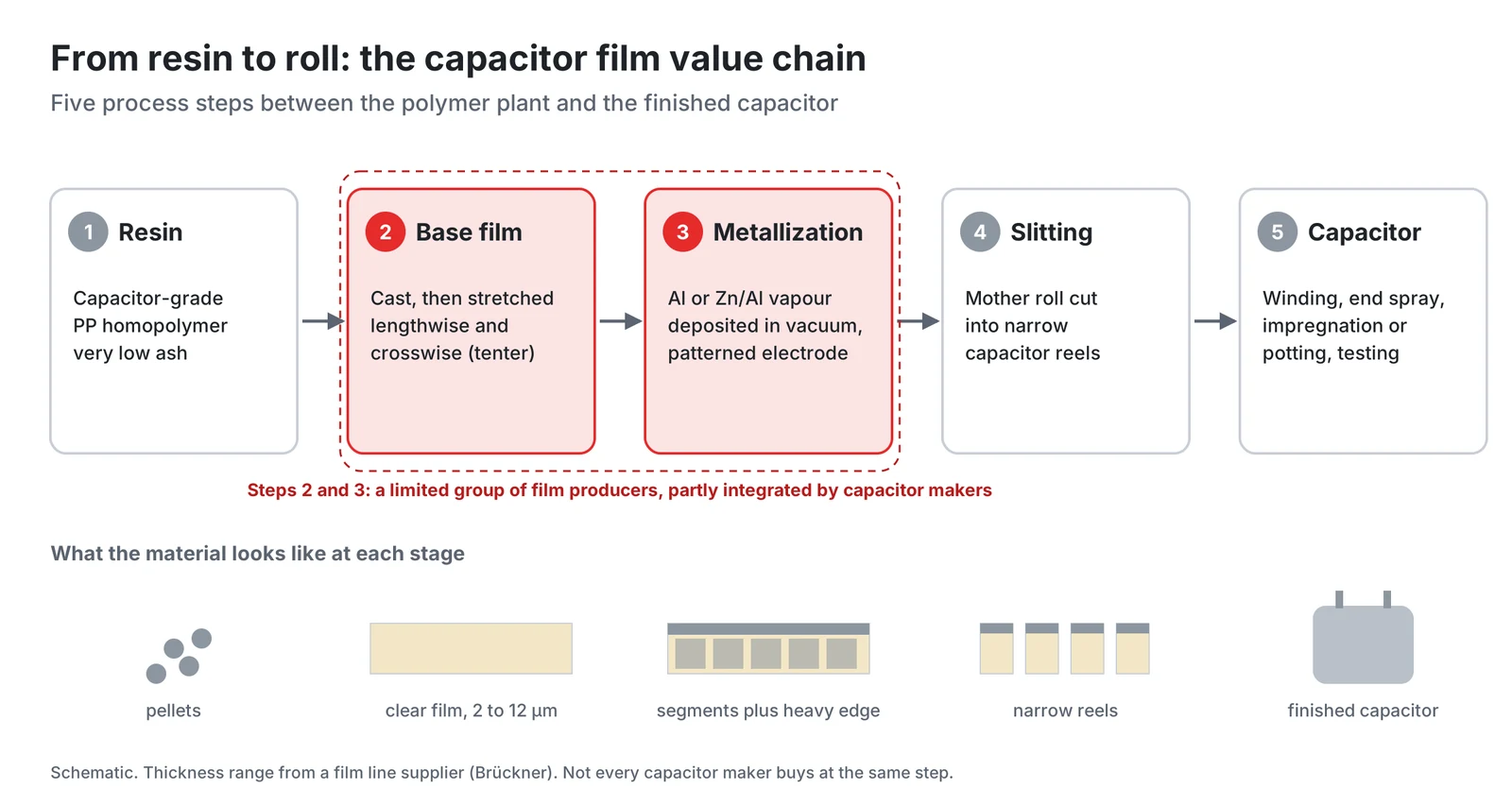
Capacitor film starts as a propylene homopolymer made specifically for electrical use, and its datasheet puts purity first. One resin producer's datasheet for a capacitor-film grade describes the product as a homopolymer "designed for usage as BOPP dielectric film in capacitor application", lists "very low ash content" among its typical characteristics and gives an ash content below 20 ppm and aluminium, titanium and chloride each below 3 ppm.
The resin is a specialised grade: the same datasheet states that reprocessed and recycled material cannot be used for the production of capacitor film. The Korean film producer Samyoung Chemical, when it announced its expansion in 2021, named the supply of polypropylene raw material imported from Japan as its problem.
Step 2: casting and biaxial stretching
The resin is then extruded into film and stretched in two directions, which gives biaxially oriented polypropylene (BOPP) its name. Dennis Zogbi of Paumanok notes, for example, that one of the major producers of large power capacitors has used the tenter-film process to extrude its own dielectric film for decades.
Thin film is not simply thick film stretched further. Samyoung's chief executive, quoted in the 2021 report, said that the film must be thinner to reduce the capacitor size and that what matters is to improve voltage resistance and thermal resistance while maintaining thinness and yield.
Step 3: metallization
The electrode is an evaporated metal layer on the film, of the order of 100 nm thick, and film suppliers offer for example aluminium-zinc metallization. The thin layer is what allows self-healing: at a local breakdown the discharge energy vaporizes the metal around the fault and electrically isolates it, and the capacitor keeps working with a loss of part of its capacitance.
Metallizers also shape the electrode. Gallay names the electrode resistance as the key parameter for good self-healing with low Joule losses: a thicker layer has a lower resistance, but more energy is involved in each self-healing event. One film supplier specifies 10 ± 3 Ω/□ in the active area and at most 3 Ω/□ on the heavy edge for an Al-Zn film for lighting capacitors. In segmented films, as the same supplier describes them, the electrode is divided into many segments, separated by demetallized insulation strips and interconnected by narrow fuses. For motor capacitors of segmented film construction, Amendment 1 of IEC 60252-1 requires class S3 parts to fail with low residual capacitance, below 1 % of the rated value. HYDRA's AC filter series, for example, are specified in the company catalogue with profile metallization and wave-cut film.
Steps 4 and 5: winding and end spray
The metallized film is wound into capacitor elements, both faces of the element are sprayed with molten metal to make the connections (schoopage), and the element is then impregnated, potted or filled with gas depending on the design. Impregnation and sealing were covered in an earlier article in this series.
A concentrated supply base
Public market data on capacitor film is scarce. Reporting on Samyoung's expansion in 2021 described about 20 companies in 10 countries producing capacitor film, a global market for ultra-thin capacitor film for electric and hydrogen vehicles monopolized by Toray because of a high technological barrier, and Samyoung itself as the world's number three capacitor film maker. Other producers describe their own positions: Terichem Tervakoski, with operations in Slovakia and Ukraine, says it controls the whole supply chain from raw materials to film production and metallizing, and calls itself the global market leader in film supplies for HVDC projects.
Part of the supply never reaches the open market. A 2024 Paumanok analysis on the Passive Components Blog found that captive extrusion of polypropylene by capacitor makers exceeds that of all other plastic film dielectrics, and that an increasing number of AC and DC film capacitor manufacturers metallize their film in house, saving the premium of buying metallized film on the merchant market.
Capacity is growing, driven by electric vehicles
The announced expansions name electric vehicles as the driver. According to the 2021 report on Samyoung, an electric car uses 150 to 330 g of ultra-thin capacitor film. Toray cited annual growth of about 20 % for electric and electrified vehicles when it announced its expansions.

Toray announced a 60 % increase in Torayfan capacity for automotive capacitors at its Tsuchiura plant in 2022, followed by a further 40 % when upgraded facilities go online in 2025. Samyoung Chemical announced in July 2021 that it would double its capacity for ultra-thin capacitor film from 550 to 1,100 t per month from the second quarter of 2023, with an investment of 30 billion won. Prince Eftex, part of the Oji Group, announced in February 2022 that its capacity for capacitor OPP film would rise to 2.3 times the current level, with operations scheduled to start in 2024. These are announcements, not verified output.
Why thinner film matters, and why it is hard
At a given voltage, the field in the film is simply E = U/d, and the energy stored per unit volume of dielectric follows from the energy density of an electric field and the dielectric constant (OpenStax University Physics, equations 8.9 and 8.11):
With εr = 2.2 for polypropylene, a design field of 200 V/µm gives w = ½ × 8.854 × 10⁻¹² F/m × 2.2 × (2 × 10⁸ V/m)² ≈ 0.39 J/cm³. Halving the thickness at the same voltage doubles the field and quadruples the energy density, which is why the film must be thinner to reduce the capacitor size. A single film layer working at 800 V reaches 200 V/µm at 4 µm. At 400 V the same field is reached at 2 µm. The 200 V/µm value is an assumption for illustration only. A 2019 study by Tampere University and VTT measured a breakdown strength of about 700 V/µm for a modern BOPP film and concluded that at current design stresses of about 200 V/µm at about 60 °C, BOPP is operated close to its fundamental thermal and electrical limitations.
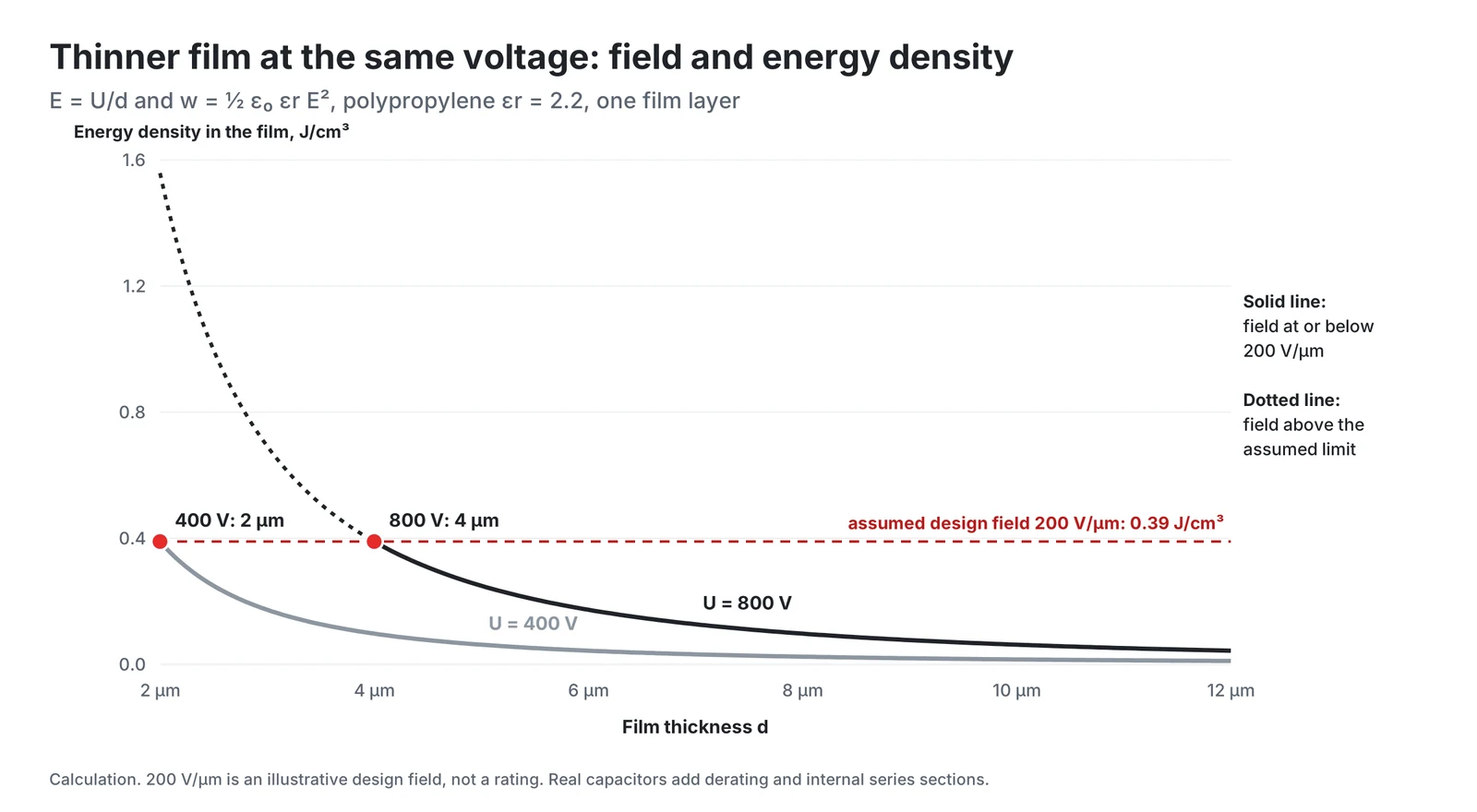
The limit is the film itself. In the same study, voltage endurance tests at higher fields revealed the onset of high-field degradation and drastically reduced insulation life. Thinner film at the same field is therefore a question of film quality and yield, which is how Samyoung described its own challenge.
What to ask your capacitor supplier
A buyer does not need to audit film lines, but a few questions reveal how well a capacitor supplier controls its own materials:
- Is the base film made in house or bought, and from how many qualified film sources?
- Who metallizes the film, and are the metallization pattern and sheet resistance part of the drawing or specification?
- Is a second film source qualified for the series you buy, and what tests were run to qualify it?
- What incoming inspection is done on film reels, for example thickness, breakdown voltage or weak spot counts?
- Will you receive a change notification if the film source, resin grade or metallization changes?
The last question matters most. The ZVEI guideline for customer notifications of product and process changes, written for automotive electronic components, includes a change assessment matrix for passive components that lists a change of material supplier and a change of material composition among the changes to be assessed for notification. It asks suppliers to inform customers well in advance of implementation so that requalification can be planned. Industrial buyers can apply the same logic in purchase agreements.
Conclusion
The capacitor film supply chain runs through a small number of highly specialised steps: a clean resin with ash below 20 ppm in the cited datasheet, a stretching process for film only micrometres thick, and a metallization whose pattern decides how the capacitor behaves when a fault occurs. Film producers have announced capacity expansions driven by electric vehicles, yet a 2021 report described the ultra-thin film market for these vehicles as dominated by one producer. For buyers, the practical response is to ask where the film comes from, how a second source is qualified and how changes are notified.
HYDRA film capacitors and documents
HYDRA builds its DC-link, AC filter, power factor correction and motor run capacitors on metallized polypropylene film, as listed in the HYDRA capacitors catalogue 2025. For the AC filter series EAB MKP, EBB MKP, ERB DPM and ECB DPM, the catalogue specifies profile metallization of the polypropylene film for better overvoltage reliability and a wave-cut film design for high RMS and peak current.
| Line | Series in the catalogue 2025 | Film detail stated in the catalogue |
|---|---|---|
| AC filter | EAB MKP, EBB MKP, ERB DPM, ECB DPM | Profile metallization, wave-cut film |
| DC-link | EGB DCL, EBB DCL | Metallized polypropylene film, dry resin filling |
| Power factor correction | PAB DPM, PMB DPM, PRB DPM, PRB DPMg | Metallized PP self-healing film |
| Motor run | MKP (S0), MKP-Si (S2) | Metallized PP self-healing film |
Further documents:
- HYDRA products, including AC filter, DC-link, power factor correction and motor capacitors
- Stock types
- HYDRA capacitors catalogue 2025 (PDF)
- Documents and certificates: ISO 9001, ISO 14001, RoHS, REACH and the conflict minerals policy
References
- Borealis AG, Borclean HC318BF product data sheet (PDF), edition 4, 28 February 2023.
- Samyoung Chemical Doubling Capacity for EV PP Capacitor Film, Shares Up 6.4%, Passive Components Blog (EPCI), 14 July 2021.
- D. Zogbi, Vertical Integration of Materials Technology in the Capacitor Industry, Passive Components Blog (EPCI), 18 December 2024.
- R. Gallay, Metallized Film Capacitor Lifetime Evaluation and Failure Mode Analysis, CERN Yellow Report CERN-2015-003, p. 45, open access, also arXiv:1607.01540.
- H. Wang, F. Blaabjerg, Reliability of Capacitors for DC-Link Applications in Power Electronic Converters: An Overview, IEEE Transactions on Industry Applications 50(5), 2014, Table I (evaporated metal).
- O. G. Gnonhoue, A. Velazquez-Salazar, É. David, I. Preda, Review of Technologies and Materials Used in High-Voltage Film Capacitors, Polymers 13(5), 766, 2021, open access (self-healing, schoopage, impregnation).
- Cosmo Films, Al-Zn segmented metallised polypropylene film, product page, accessed 18 October 2026.
- IEC 60252-1:2010/AMD1:2013, definition 3.22.4 (S3), free sample of SIST EN 60252-1:2011/A1:2014.
- HYDRA a.s., Hydra Capacitors catalogue 2025 (PDF), AC filter capacitors.
- AMI, In conversation with Jari-Pekka Nurminen (Terichem Tervakoski), 20 November 2025.
- Toray Boosting Polypropylene Film Production Capacity to Meet Growing Demand for Automotive Capacitors, Passive Components Blog (EPCI).
- Toray to Boost Polypropylene Film Production to Meet Rising Automotive Capacitor Demand, Passive Components Blog (EPCI).
- Oji Group Functional Materials Company, Notice regarding the expansion of production facilities for polypropylene film for capacitors (Prince Eftex), 28 February 2022.
- M. Ritamäki, I. Rytöluoto, K. Lahti, Performance Metrics for a Modern BOPP Capacitor Film, IEEE Transactions on Dielectrics and Electrical Insulation 26(4), 2019, abstract.
- OpenStax, University Physics Volume 2, 8.3 Energy Stored in a Capacitor and 8.4 Capacitor with a Dielectric.
- ZVEI, Guideline for Customer Notifications of Product and/or Process Changes (PCN) of Electronic Components specified for Automotive Applications, Rev. 5.1 (PDF), July 2024, Table 2.
Products in this article
Reliability & materials
Check stockAsk a HYDRA engineer
Send us your application data and our engineers will help you choose the right film capacitor. HYDRA has made film capacitors since 1899, with production in Jičín (Czech Republic) and Da Nang (Vietnam).
Ask an engineerCheck stock