Beyond 105 °C: The Limits of BOPP and the Next Generation of Capacitor Films
In this article
Biaxially oriented polypropylene (BOPP) is the preferred film for capacitors rated above about 250 V, according to a review of DC-link capacitor reliability, and a 2021 review of high-voltage film capacitors calls it the current choice for capacitors used in high-voltage applications. HYDRA's 2025 catalogue lists metallized polypropylene for its motor run, power factor correction, AC filter and DC-link lines alike. The material has earned that position, but it has one clear limit: temperature. Demand for capacitors that work at elevated temperatures is growing, for example in electric vehicles, renewable energy and aerospace power systems, and designers ask what comes after polypropylene.
This article looks at why BOPP dominates, why it stops at about 105 °C, how the other commercial films compare and which new materials are commercial, close or still in the laboratory.
Key takeaways
- Polypropylene dominates power film capacitors because it combines the lowest dissipation factor of the common films with the highest breakdown strength in the review's table and good self-healing.
- Its limit is temperature: the review gives 105 °C as its maximum operating temperature, and above it conduction losses can lead to thermal runaway.
- When evaluating any new dielectric, ask at which temperature the full rated voltage still applies.
Why polypropylene became the default
The 2021 review describes polypropylene as the most widely used film for high-voltage and high-frequency applications, with a dielectric constant of about 2.2, a very low dissipation factor of 10⁻⁴ and a dielectric strength of about 700 V/µm in thin films. The summary table of the same review lists a dielectric constant of 2.2, a dissipation factor of 0.02 % at 1 kHz and an approximate breakdown strength of 640 MV/m (640 V/µm).
The low loss is what matters most in power applications. At a given AC field and frequency, the power dissipated per unit volume of a dielectric is proportional to the product εr × tan δ. Using the same table, polyester (PET) has εr = 3.3 and a dissipation factor of 0.5 %, so 3.3 × 0.005 = 0.0165. Polypropylene gives 2.2 × 0.0002 = 0.00044. Under AC or ripple current, PET therefore dissipates about 37 times more heat per unit volume at the same field and frequency.
The third reason is self-healing. When a weak spot in the film breaks down, the energy of the discharge is generally sufficient to vaporize the metallization around the defect, as the 2021 review puts it, and the capacitor loses part of its capacitance but regains its insulation and continues to operate.
Why the limit sits at 105 °C
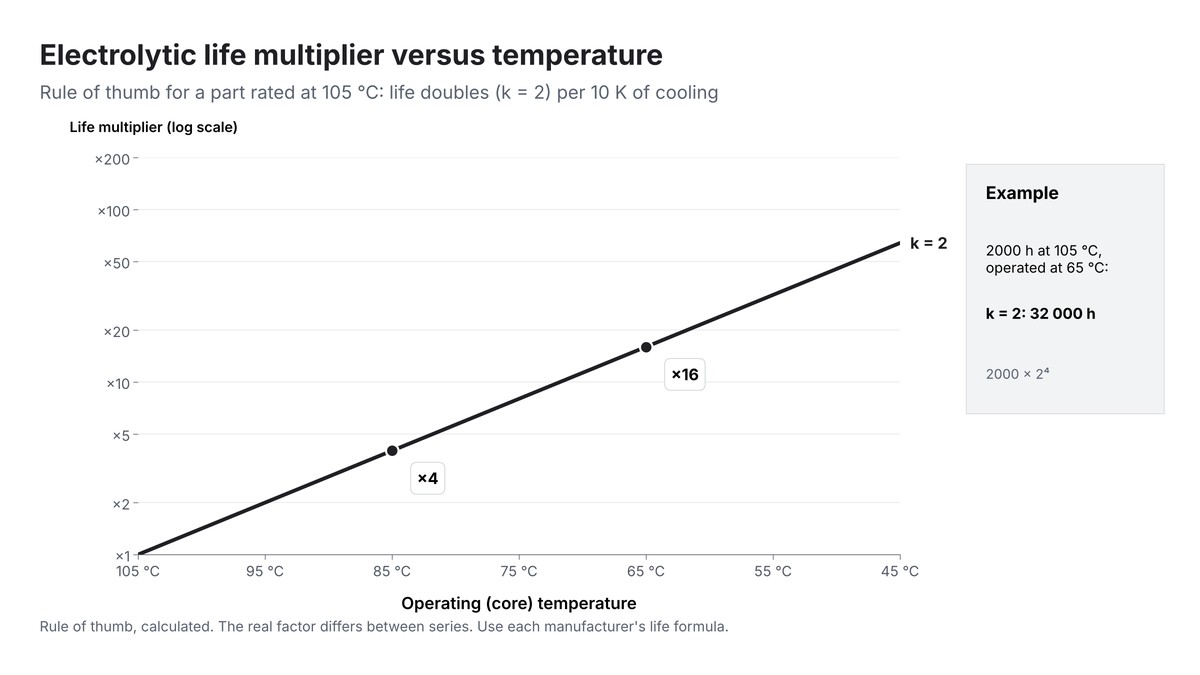
The 105 °C ceiling is not arbitrary. The 2021 review gives 105 °C as the maximum operating temperature of biaxially oriented polypropylene and notes that its very low dissipation factor is essentially frequency-independent at temperatures below 100 °C. A 2025 paper in Nature Communications describes BOPP as limited to operating temperatures below 105 °C, beyond which temperature and field dependent conduction losses in the film can generate significant Joule heat, potentially resulting in thermal runaway of the capacitor.
The limit is therefore thermal and electrical at the same time: the conduction loss grows with both temperature and field, the heat it produces raises the temperature further, and above the limit this loop can run away.
The other commercial films
Polypropylene is not the only commercial capacitor film. The table below reproduces the values of the 2021 review (Table 5), which compiles them from the literature.
| Film | Dielectric constant | Dissipation factor at 1 kHz (%) | Approximate breakdown strength (MV/m) | Operating temperature (°C) |
|---|---|---|---|---|
| PP | 2.2 | 0.02 | 640 | -55 to 105 |
| PET | 3.3 | 0.5 | 570 | -55 to 125 |
| PEN | 3 | 0.4 | 400 | -55 to 137 |
| PPS | 3 | 0.05 | 550 | -55 to 200 |
| PTFE | 2.1 | 0.05 | 296 | 260 |
Ratings differ between sources: the text of the same review, for example, gives 150 °C as the usable temperature of PET. The datasheet of the series in question is always the final reference.
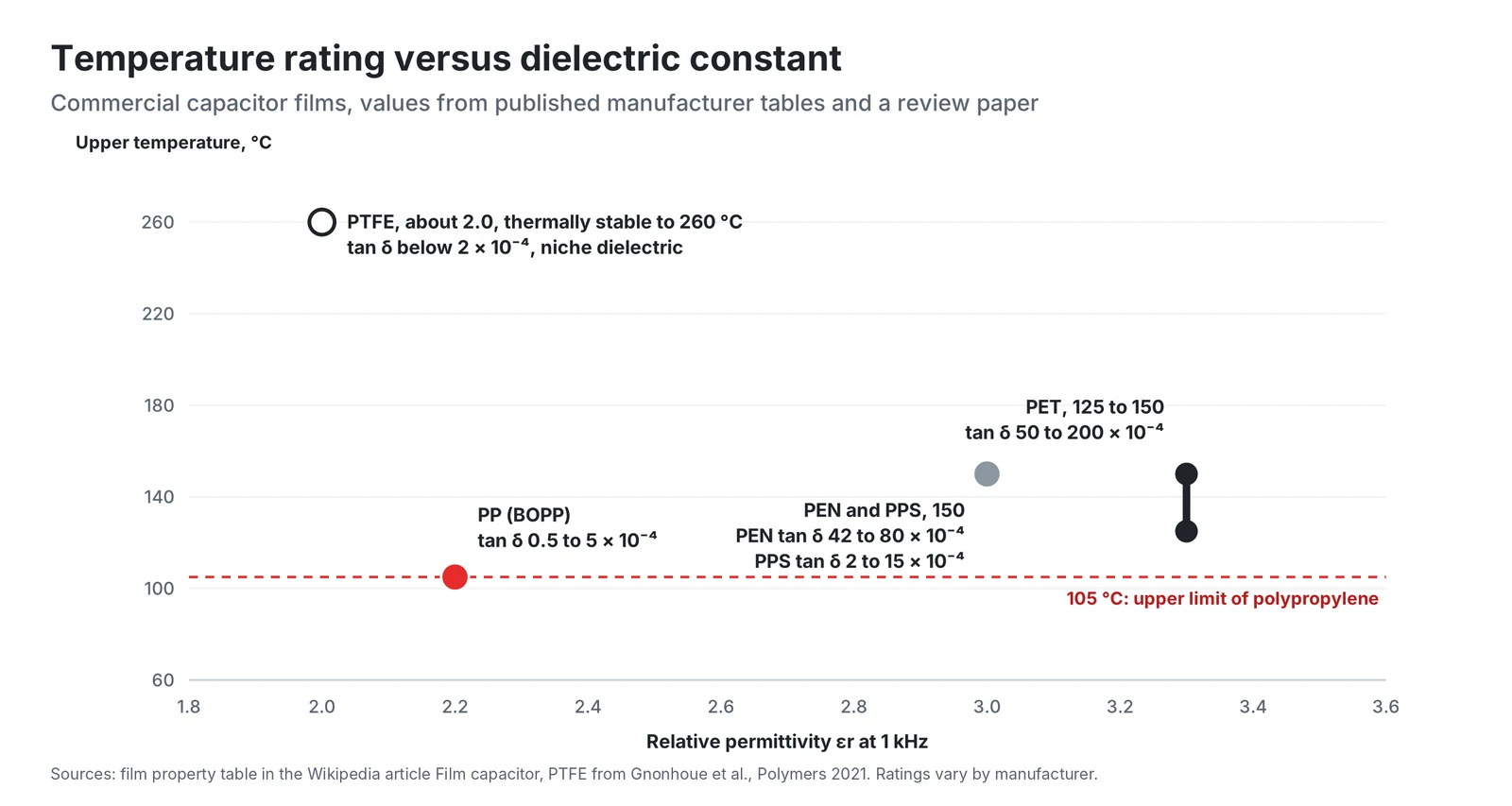
PET and PEN offer a higher dielectric constant and a higher temperature, but their dissipation factor in the table is 20 to 25 times that of polypropylene. PPS comes closest to polypropylene in loss, with 0.05 %, and the table lists operation up to 200 °C, but its breakdown strength of 550 MV/m is lower. PTFE is thermally stable up to 260 °C but has the lowest breakdown strength in the table, 296 MV/m.
What energy density really means
The energy stored per unit volume of a linear dielectric follows from the energy density of an electric field in free space, ½ × ε0 × E², and from the dielectric constant, which multiplies the capacitance (OpenStax University Physics, equations 8.9 and 8.11):
where ε0 = 8.854 × 10⁻¹² F/m and E is the electric field in the film. For polypropylene at the breakdown strength of 640 MV/m listed in the review (6.4 × 10⁸ V/m):
This is a ceiling at breakdown, not a working value. A capacitor operates far below the breakdown field. At an assumed example working field of 125 V/µm, polypropylene stores 0.15 J/cm³.
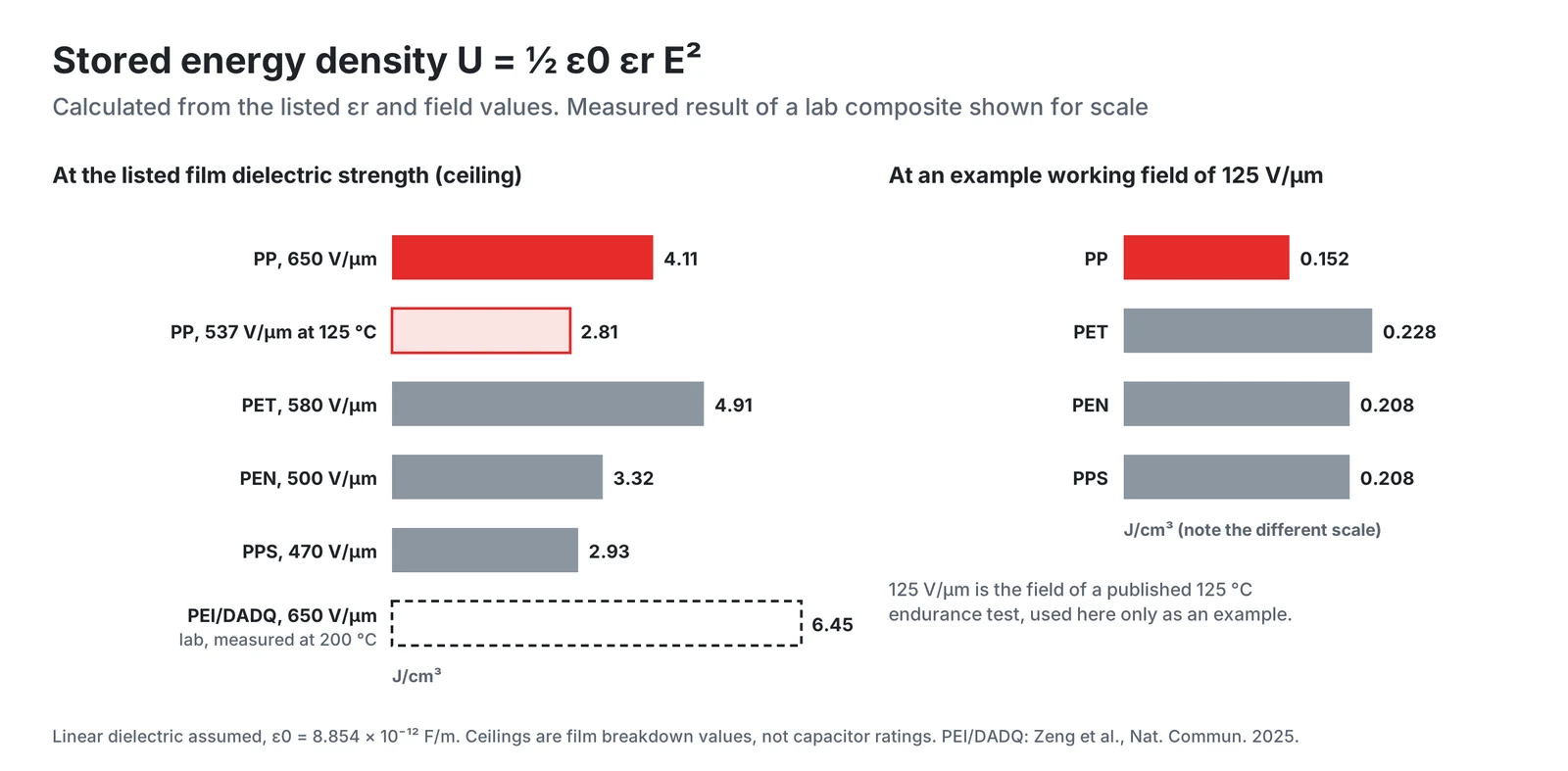
At the same working field PET stores 0.23 J/cm³ instead of 0.15 J/cm³, but with far higher loss. The laboratory results described below are high because the films hold fields of 650 to 700 MV/m at 150 to 200 °C, not because of permittivity alone.
What is commercial now
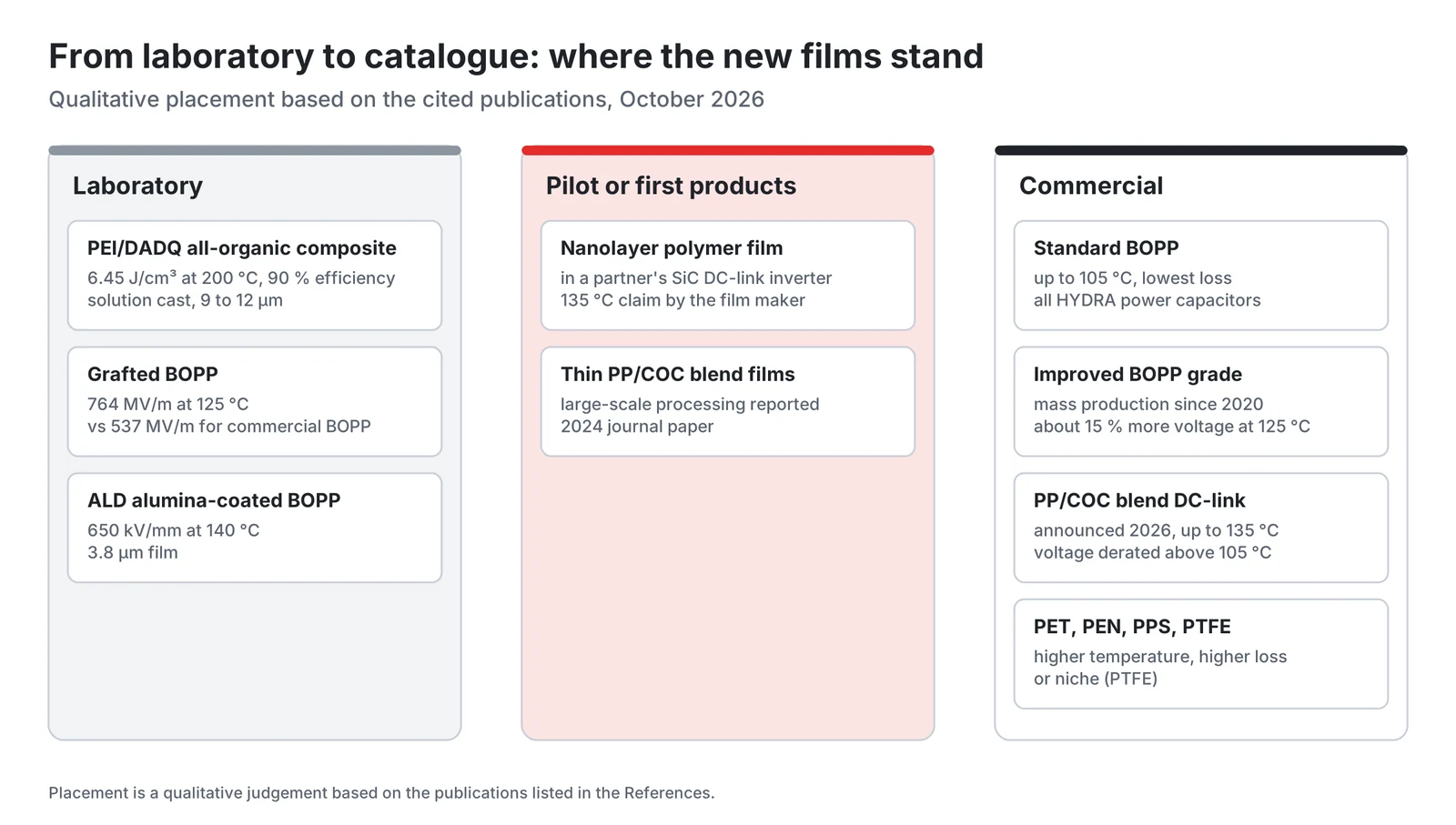
Improved polypropylene grades. Film producers have continued to refine BOPP itself. Toray has announced mass manufacturing of an advanced grade of its BOPP capacitor film for electrified vehicles, with a voltage resistance around 15 % greater than that of conventional counterparts at 125 °C and a thermal resistance increased by at least 5 °C, as reported by EPCI.
What is close, and what is still in the laboratory
Nanolayer films. A US film developer, Peak Nano, describes its NanoPlex LDF film on its product page as rated for 135 °C operation without derating, with a dissipation factor of 0.00025, and states that it was chosen as the film for DC-link capacitors aimed at SiC inverters of 800 V and higher. These are the company's own claims.
Polyetherimide (PEI) and all-organic composites. PEI has a glass transition temperature above 200 °C. The Nature Communications paper adds 0.5 vol% of a small organic molecule (DADQ, 2,5-diamino-3,6-dicyano-1,4-benzoquinone) to PEI and reports a discharged energy density of 6.45 J/cm³ with 90 % efficiency at 200 °C and 650 MV/m, and 7.19 J/cm³ with 93.9 % efficiency at 150 °C and 700 MV/m. Pure PEI reached 2.75 J/cm³ at 200 °C. The films were solution cast to a thickness of 9 to 12 µm in the laboratory. The authors describe the method as scalable, but these are laboratory results on film samples, not data for wound, metallized capacitors.
Modified polypropylene. In the laboratory, a biaxially oriented film of grafted polypropylene reached a discharged energy density of 4.5 J/cm³ at above 90 % efficiency at 125 °C, according to the abstract of a 2023 paper by authors from Tsinghua University and the SINOPEC Beijing Research Institute of Chemical Industry, who describe the film as scalable.
What this means for capacitor users
For most industrial applications standard BOPP remains the usual choice: the HYDRA catalogue, for example, gives operating temperature ranges up to +85 °C for its polypropylene capacitor lines. Where the environment is hotter, improved BOPP grades and new films are appearing, but their high-temperature ratings so far come mostly from their producers. A higher-temperature film widens the window, it does not replace careful thermal design.
Conclusion
Polypropylene dominates power film capacitors because it combines the lowest dissipation factor of the common films with the highest breakdown strength in the review's table and good self-healing. Its limit is temperature: the review gives 105 °C as its maximum operating temperature, and above it conduction losses can lead to thermal runaway. PET, PEN and PPS tolerate more heat but with more loss or lower strength. The next generation is arriving in stages: improved BOPP grades are in mass production according to their producer, nanolayer films are offered on the basis of company claims, and PEI-based composites show laboratory results at 200 °C that still have to be proven in wound capacitors. When evaluating any new dielectric, ask at which temperature the full rated voltage still applies.
HYDRA film capacitors and documents
The HYDRA capacitors catalogue 2025 lists metallized polypropylene as the dielectric of all four HYDRA power capacitor lines: DC-link (EGB DCL and EBB DCL), AC filter (EAB MKP, EBB MKP, ERB DPM and ECB DPM), power factor correction (PAB DPM, PMB DPM, PRB DPM and PRB DPMg) and motor run capacitors (MKP and MKP-Si). The catalogue gives operating temperature ranges up to +85 °C for these lines, within the polypropylene window described above.
Further documents:
- HYDRA products, including DC-link, AC filter, power factor correction and motor capacitors
- Stock types
- HYDRA capacitors catalogue 2025 (PDF), with dielectric, temperature range and life data for each line
- DC-link datasheet (PDF)
- Documents and certificates: ISO 9001, RoHS and REACH
References
- HYDRA a.s., Hydra Capacitors catalogue 2025 (PDF).
- O. G. Gnonhoue, A. Velazquez-Salazar, É. David, I. Preda, Review of Technologies and Materials Used in High-Voltage Film Capacitors, Polymers 13(5), 766, 2021, open access, section on polymer films and Table 5.
- H. Wang, F. Blaabjerg, Reliability of Capacitors for DC-Link Applications in Power Electronic Converters: An Overview, IEEE Transactions on Industry Applications 50(5), 2014, Fig. 3.
- T. Zeng, L. Meng, Q. Li et al., Enhancing energetic disorder in all-organic composite dielectrics for high-temperature capacitive energy storage, Nature Communications 16, 5620, 2025, open access.
- OpenStax, University Physics Volume 2, 8.3 Energy Stored in a Capacitor, equation 8.9, and 8.4 Capacitor with a Dielectric, equation 8.11.
- EPCI, Toray Commercializes Advanced Grade of Polypropylene Capacitor Film that Enhances Electrified Vehicle Design Flexibility and Fuel Economy.
- Peak Nano, NanoPlex LDF capacitor film, product page, accessed 18 October 2026.
- Biaxially oriented films of grafted-polypropylene with giant energy density and high efficiency at 125 °C, Journal of Materials Chemistry A 11(20), 2023, abstract.
Products in this article
Reliability & materials
Check stockAsk a HYDRA engineer
Send us your application data and our engineers will help you choose the right film capacitor. HYDRA has made film capacitors since 1899, with production in Jičín (Czech Republic) and Da Nang (Vietnam).
Ask an engineerCheck stock