Vegetable Oil, Resin or Gas: How Impregnation and Sealing Decide Film Capacitor Life
In this article
- Why moisture and air are the enemies of a metallized film
- Three ways to fill a capacitor
- Oil-filled cans: the oil is a component, not a filler
- Resin-potted designs: case and resin as the barrier
- Sealing is part of the safety concept
- What to ask your capacitor supplier
- Conclusion
- HYDRA capacitor constructions and documents
- References
Datasheets of film capacitors describe the film: polypropylene, metallized, self-healing. HYDRA's datasheets also name the filling, for example vegetable oil or polyurethane resin, and that part of the design matters for life. The speed at which a metallized film capacitor loses capacitance depends on the temperature, the voltage and the humidity, and what surrounds the winding decides how much moisture reaches it.
This article explains why moisture and trapped gas shorten the life of a metallized film, how oil impregnation, resin potting and gas filling deal with them, and which production factors decide whether the protection works.
Key takeaways
- The speed at which a metallized film capacitor loses capacitance depends on the temperature, the voltage and the humidity, and what surrounds the winding decides how much moisture reaches it.
- Moisture corrodes the thin electrodes, gas gaps allow corona discharge at their edges, and moisture lowers the insulation resistance.
- Oil-filled cans, resin-potted cases and gas-filled designs keep moisture away in different ways, and drying and sealing in production are among the factors that decide whether they work.
Why moisture and air are the enemies of a metallized film
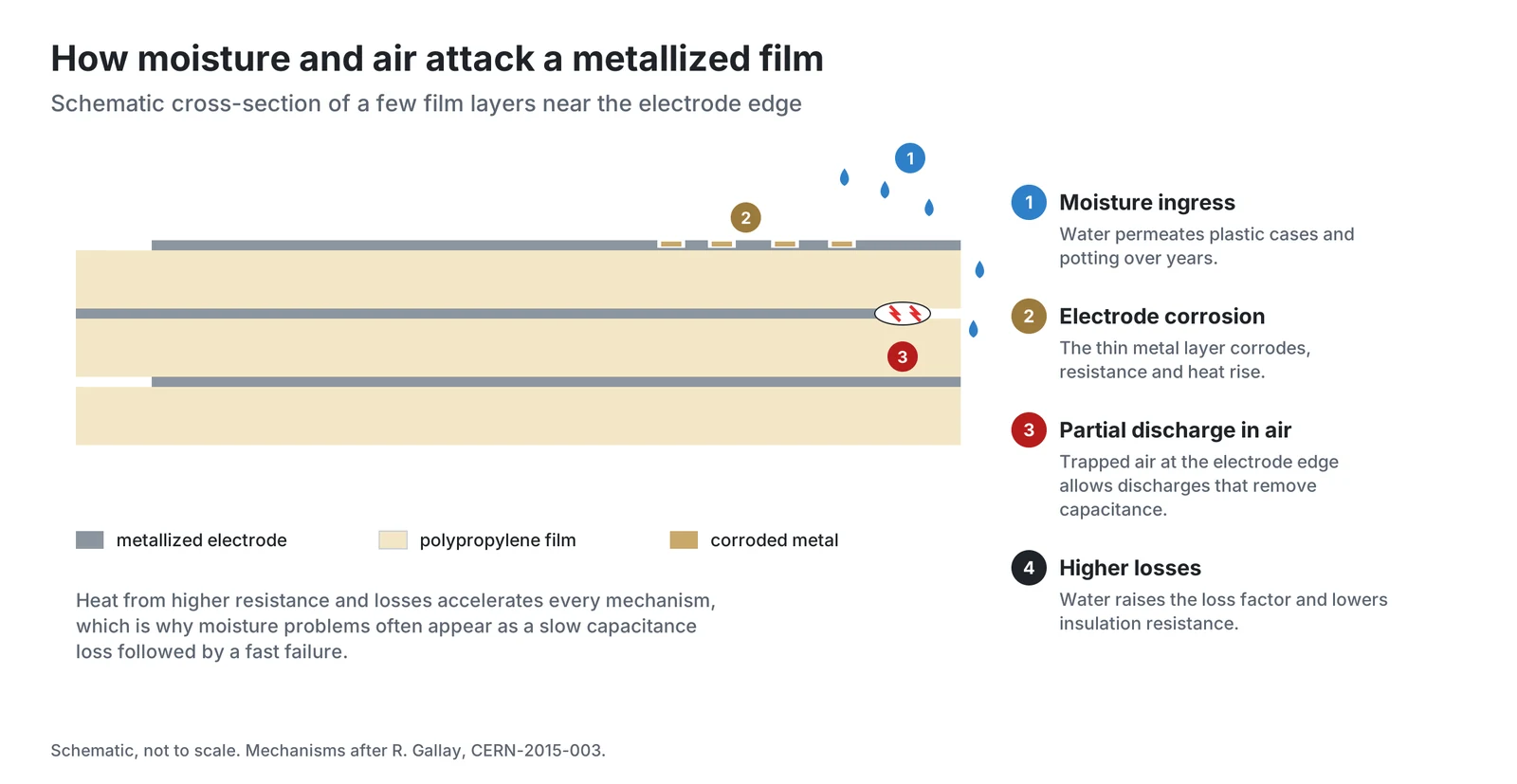
The electrode of a metallized polypropylene capacitor is a metal layer typically less than 100 nm thick, which makes it susceptible to corrosion when atmospheric moisture gets in. Humidity in the capacitor, from poor drying in production, from a material with too high a moisture permeability or from a humid installation, can lead to three failure modes.
- Electrode corrosion. Moisture corrodes the thin metallization and the series resistance slowly increases. The loss factor and the heat dissipation rise, and the higher temperature accelerates the capacitance loss. Plastic containers are not completely moisture tight, as there is always some residual permeability in polymers.
- Corona discharge in gas gaps. Gas in the gaps between the films has a lower dielectric strength than the film. At the electrode edges, where the field is more intense, corona discharges demetallize the electrode and the capacitance falls fast. A drop in the dielectric strength of that gas, or poor control of the gap during winding, makes this worse.
- Lower insulation resistance. The third mode is a reduction of the insulation resistance. Moisture left in the winding also causes accelerated ageing and bigger losses.
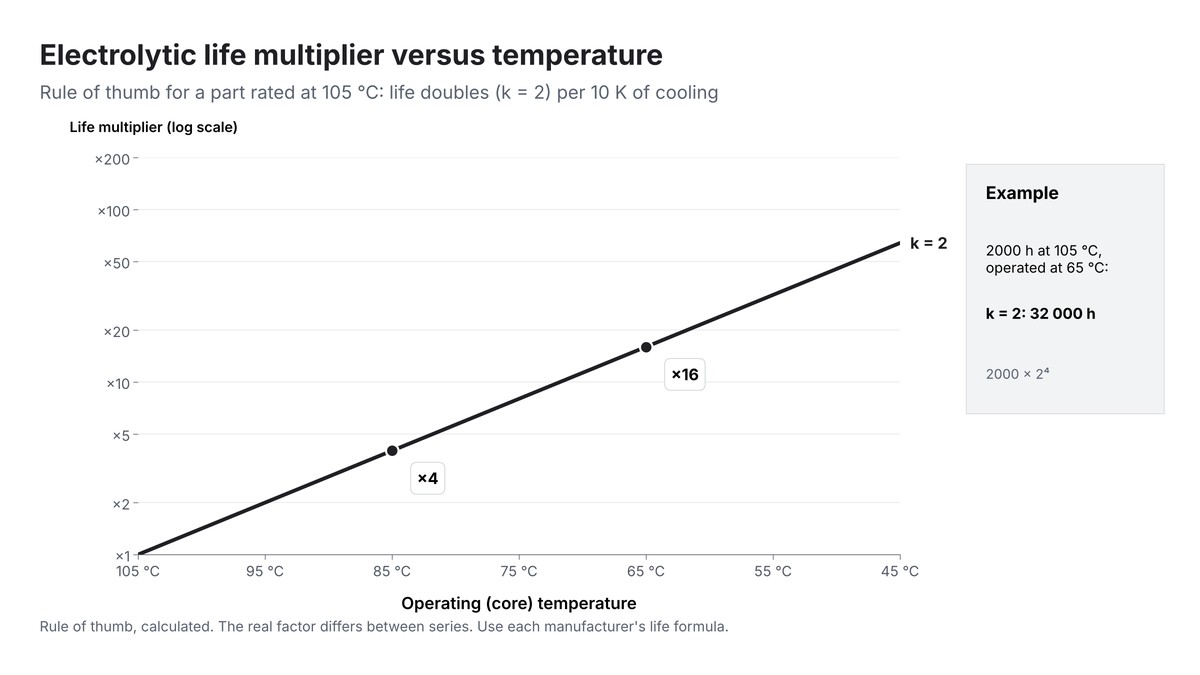
Lifetime models for metallized film capacitors therefore treat humidity as a stress alongside temperature and voltage.
Three ways to fill a capacitor
Every design has to keep moisture away from the winding and avoid gas gaps in it. The common construction families do this in different ways. The table uses HYDRA's own products as examples.
| Oil-filled metal can | Resin-potted plastic case | Gas-filled or dry can | |
|---|---|---|---|
| Moisture barrier | Aluminium can, sealing test in IEC 60252-1 (5.12) | Plastic case, not completely moisture tight | Closed can |
| Filling | Vegetable oil | Self-extinguishing polyurethane resin | Nitrogen gas, or dry polyurethane or epoxy resin |
| Safety device | Overpressure disconnector in HYDRA S2 motor capacitors | None in HYDRA S0 motor capacitors | Overpressure expansion fuses in HYDRA PFC capacitors |
| HYDRA examples | Motor run S2 (321, 322, 500), motor start 330, PFC PAB and PRB DPM(d) | Motor run S0 (285, 400) | PFC PMB and PRB DPMg (N2), DC link (dry resin, aluminium case) |
Oil-filled and gas-filled cans can carry an overpressure disconnector, as described in the first article of this series. Resin-potted plastic designs rely on the resin and the case, and plastic is not completely moisture tight. Gas-filled and dry designs avoid liquid filling altogether.

Oil-filled cans: the oil is a component, not a filler
In power capacitors the dried elements are impregnated either with vegetable oil or with a gas such as nitrogen. HYDRA's aluminium-can motor capacitors use a vegetable oil filling. Vegetable oil is not a PCB. PCBs were manufactured in the United States until their manufacture was banned in 1979, and old electrical devices or appliances may still contain PCB capacitors.
Drying the winding. The capacitive elements must be dried to remove moisture, which would cause accelerated ageing and bigger losses if left in the capacitor.
Production causes of failure. Among the production causes of capacitor failure, Gallay names poor mechanical tension control during winding, bad drying that leaves too high a humidity content in the capacitor, and bad sealing.

Resin-potted designs: case and resin as the barrier
HYDRA's unprotected S0 motor capacitors, series 285 and 400, are built in a plastic case and potted with a self-extinguishing polyurethane resin. Plastic containers are not completely moisture tight, so some residual permeability always remains.
The insulating materials also have to meet fire requirements. IEC 60252-1 includes ball-pressure, glow-wire and tracking tests (5.17), and IEC 60335-1 for household appliances references the IEC 60695 glow-wire and ball-pressure test methods.
Sealing is part of the safety concept
In a class S2 capacitor the seal does more than keep moisture out. The overpressure disconnector works through a rise of internal pressure caused by gas generation and a temperature increase, so it needs a closed can.
IEC 60252-1 includes a sealing test (5.12) and a damp-heat test (5.14). The severity of the damp-heat test is the last figure of the climatic category, which HYDRA datasheets write as Tmin / Tmax / damp heat severity, for example 25/85/21. The standard distinguishes type tests, which qualify a design, from routine tests on production (5.2), and HYDRA's motor capacitor datasheets state a 100 % routine test.
What to ask your capacitor supplier
These points can be asked during qualification or a supplier audit.
- Which impregnant or potting material is used, and is it free of substances restricted by RoHS and REACH?
- How is the winding dried and stabilised before filling or potting?
- What is the specified water content of the oil at filling, and how is it measured?
- How are the mixing ratio and dosing of potting resin controlled?
- Is every oil-filled part leak-tested, and by what method?
- Which damp-heat test results are available for the series?
- Which flammability ratings do the case and the resin carry?
Conclusion
The film defines what a capacitor can do, while the impregnation and the seal influence how long it keeps doing it, because humidity is one of the stresses that set the speed of capacitance loss. Moisture corrodes the thin electrodes, gas gaps allow corona discharge at their edges, and moisture lowers the insulation resistance. Oil-filled cans, resin-potted cases and gas-filled designs keep moisture away in different ways, and drying and sealing in production are among the factors that decide whether they work.
HYDRA capacitor constructions and documents
HYDRA builds film capacitors in all three construction families described above. According to the HYDRA datasheets and the HYDRA catalogue 2025, the S2 motor capacitors use an aluminium can with a vegetable oil filling and an overpressure disconnector, while the S0 motor capacitors use a plastic can with a self-extinguishing polyurethane resin. PFC capacitors are offered gas (N2) filled or with oil or soft resin, and DC-link capacitors have a dry polyurethane or epoxy resin filling.
| Product family | Series | Case | Filling |
|---|---|---|---|
| Motor run, S2 | 321, 322, 500 | Aluminium can | Vegetable oil |
| Motor start | 330 | Aluminium can | Vegetable oil |
| Motor run, S0 | 285, 400 | Plastic can | Polyurethane resin, self-extinguishing |
| PFC | PMB DPM(d), PRB DPMg | Cylindrical can | Gas (N2) |
| PFC | PAB DPM(d), PRB DPM(d) | Cylindrical can | Oil or soft resin |
| DC link | EGB DCL, EBB DCL | Aluminium can | Dry polyurethane or epoxy resin |
Further documents:
- Motor capacitor datasheets: series 321 (PDF), series 322 (PDF), series 500 (PDF), series 330 (PDF), series 285 (PDF), series 400 (PDF)
- DC-link capacitors datasheet (PDF)
- HYDRA capacitors catalogue 2025 (PDF), with PFC, AC filter, DC-link and motor capacitors
- RoHS declaration 2026 (PDF) and REACH declaration 2026 (PDF)
- Documents and certificates
- Services, including the HYDRA test laboratory
References
- IEC 60252-1:2010+AMD1:2013 CSV, AC motor capacitors, Part 1. Free IEC preview (table of contents with 5.2, 5.12, 5.14 and 5.17).
- R. Gallay, Metallized Film Capacitor Lifetime Evaluation and Failure Mode Analysis, CERN Yellow Reports CERN-2015-003, CAS-CERN Accelerator School: Power Converters. doi:10.5170/CERN-2015-003.45, sections 1 to 3.
- H. Wang, F. Blaabjerg, Reliability of Capacitors for DC-Link Applications in Power Electronic Converters: An Overview, IEEE Transactions on Industry Applications 50(5), 2014. Free version of record, Aalborg University, section III.A (metallized layer less than 100 nm, corrosion).
- IEC 60335-1:2020, Household and similar electrical appliances, Safety, Part 1. Free IEC preview (Clause 2, IEC 60695 references).
- US Environmental Protection Agency, Learn about Polychlorinated Biphenyls.
- HYDRA datasheets series 285 and series 321 (construction, climatic category notation, 100 % routine test).
Products in this article
Reliability & materials
Check stockAsk a HYDRA engineer
Send us your application data and our engineers will help you choose the right film capacitor. HYDRA has made film capacitors since 1899, with production in Jičín (Czech Republic) and Da Nang (Vietnam).
Ask an engineerCheck stock