Film Capacitors in AI Data Center Power: From 800 VDC Distribution to Power Quality
In this article
Rack power in AI data centers is moving towards the megawatt, and the conventional way of bringing power to the rack is being questioned. NVIDIA has proposed an 800 VDC architecture for racks ranging from 100 kW to over 1 MW, and Google, Meta and Microsoft are standardising ±400 VDC power delivery within the Open Compute Project.
For capacitor engineers the question is where the capacitors sit in each architecture and what they have to do. This article follows the power chain, marks the positions of film capacitors, and uses a simple calculation to show what a DC link can and cannot do against the fast load swings of AI workloads.
Key takeaways
- AI data centers move power conversion out of the rack and towards higher DC voltages: 800 VDC in NVIDIA's architecture, ±400 VDC in the Open Compute Mt Diablo work.
- In the example above, a film DC link of 2 mF carries a megawatt rack for only about 60 microseconds.
- Each storage stage should be sized for its own time scale.
The power chain today and tomorrow
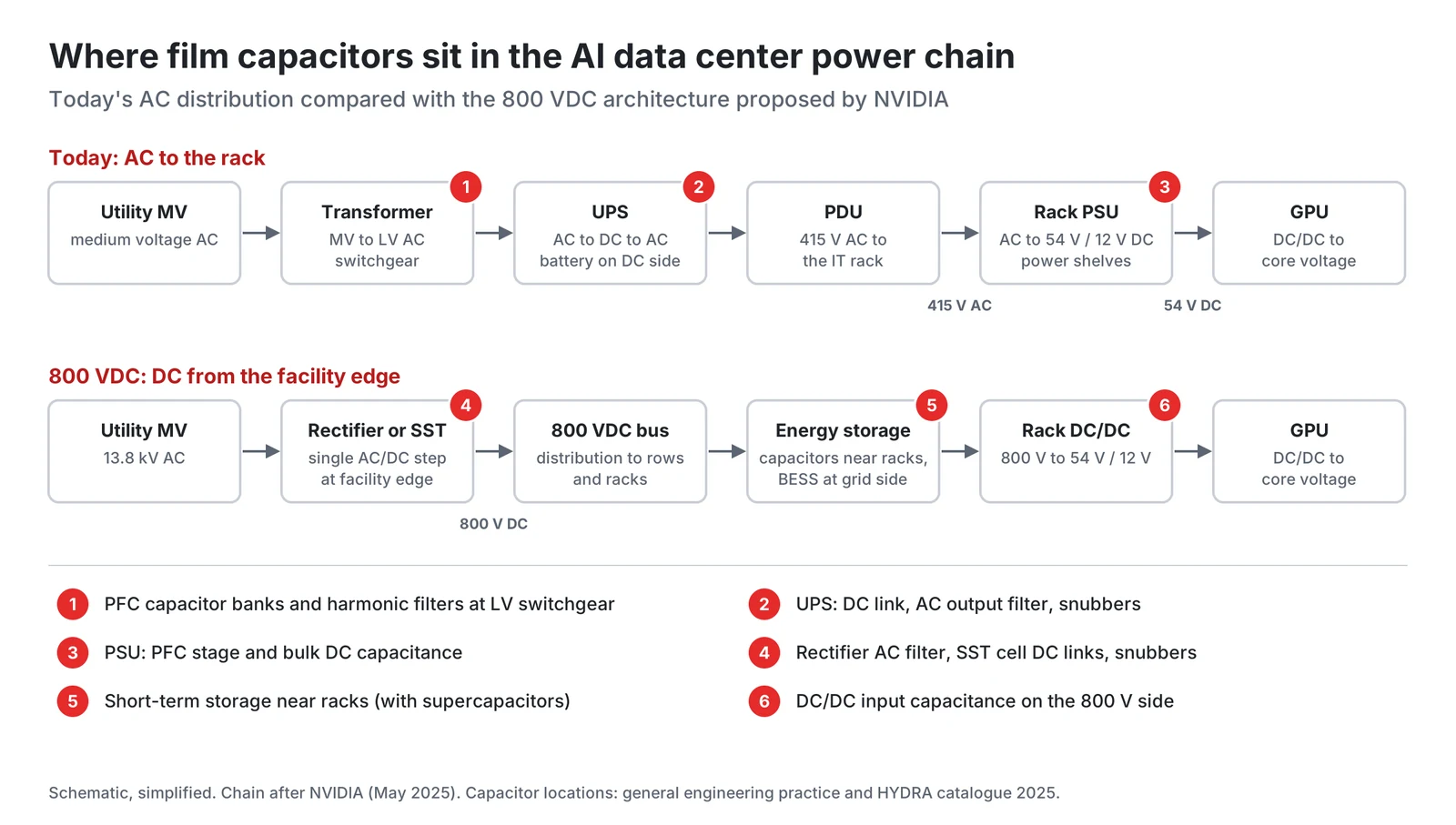
NVIDIA describes today's AI racks as relying on 54 VDC power distribution, where bulky copper busbars carry electricity from rack-mounted power shelves to the compute trays, and compares its new architecture with 415 VAC distribution. According to NVIDIA, a single 1 MW rack at 54 VDC would need up to 200 kg of copper busbar.
The 800 VDC architecture, published by NVIDIA in May 2025, converts 13.8 kV AC grid power directly to 800 VDC at the data center perimeter using industrial-grade rectifiers, which eliminates most intermediate conversion steps. Inside the rack, DC/DC conversion drives the GPUs, shown in NVIDIA's figure as conversion to 12 V. NVIDIA studies both transformer-based and solid-state transformer (SST) approaches, targets 1 MW IT racks starting in 2027 together with its Kyber rack-scale systems, and claims up to 5 % better end-to-end efficiency and 45 % less copper compared with 415 VAC distribution.
A parallel path comes from the Open Compute Project. In the Mt Diablo project, Google, Meta and Microsoft work on ±400 VDC power delivery supporting up to 1 MW per rack. Its first embodiment is an AC-to-DC sidecar power rack that disaggregates power components from the IT rack.
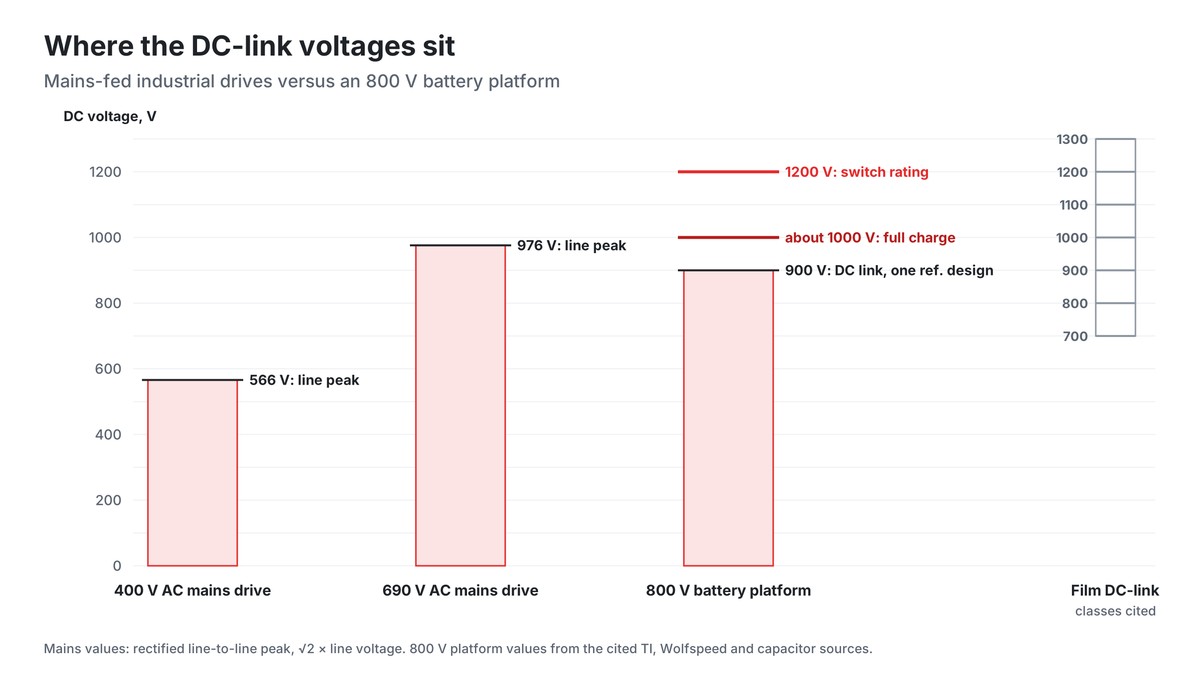
For passive components both routes point the same way. NVIDIA expects far fewer power supply units in the chain, and the Open Compute sidecar moves the AC-to-DC conversion out of the IT rack. The DC voltages rise to the range in which, according to Wang and Blaabjerg, metallized polypropylene film capacitors offer a well-balanced performance, for example above 500 V.
Where film capacitors appear
Going along the chain in Figure 1, film capacitors appear in the following functions.
- UPS and inverters. The HYDRA catalogue 2025 lists DC filtering in industrial inverters and AC filter capacitor banks in UPS among the applications of its DC-link capacitors, and UPS systems among the applications of its AC filter capacitors.
- Solid-state transformers. An SST replaces the 50 or 60 Hz transformer with power electronics. A Wolfspeed article describes a typical SST as several cascaded converter cells built around their DC buses, switching at frequencies higher than 10,000 Hz and converting the 13.8 to 35 kV AC input to 800 VDC. Each of these DC buses is a DC-link position.
- Snubbers. Fast semiconductors produce voltage spikes at switching events. Filter capacitors for damping these spikes are a catalogue application of HYDRA AC filter capacitors.
- Facility-level power factor correction and harmonic filters. Wherever the AC part of the chain remains, capacitor banks compensate reactive power, and with filter reactors they form detuned or tuned banks.
The EPCI market overview for 2026, based on research by Paumanok and TTI Europe, puts these functions into a market context. It states that plastic film capacitors represent around half of industrial capacitor market value and remain the primary dielectric for power factor correction, smoothing and burst power. It names the expansion of AI data center infrastructure as one of four structural growth forces and lists film DC bus capacitors among the components required by AI racks in the 30 to 100 kW+ range.
Load swings: what a DC link can do
AI training loads are not steady. In a later blog from October 2025, NVIDIA writes that the power draw of a rack can swing from an idle state of around 30 % to 100 % utilization and back again in milliseconds, and that synchronized GPU workloads represent hundreds of megawatts ramping up and down in seconds. The 800 VDC concept therefore includes energy storage at two levels: high-power capacitors and supercapacitors close to the racks for the milliseconds to seconds range, and battery energy storage systems at the utility interconnection for seconds to minutes.
Where does the film DC link fit? A simple energy calculation answers it.
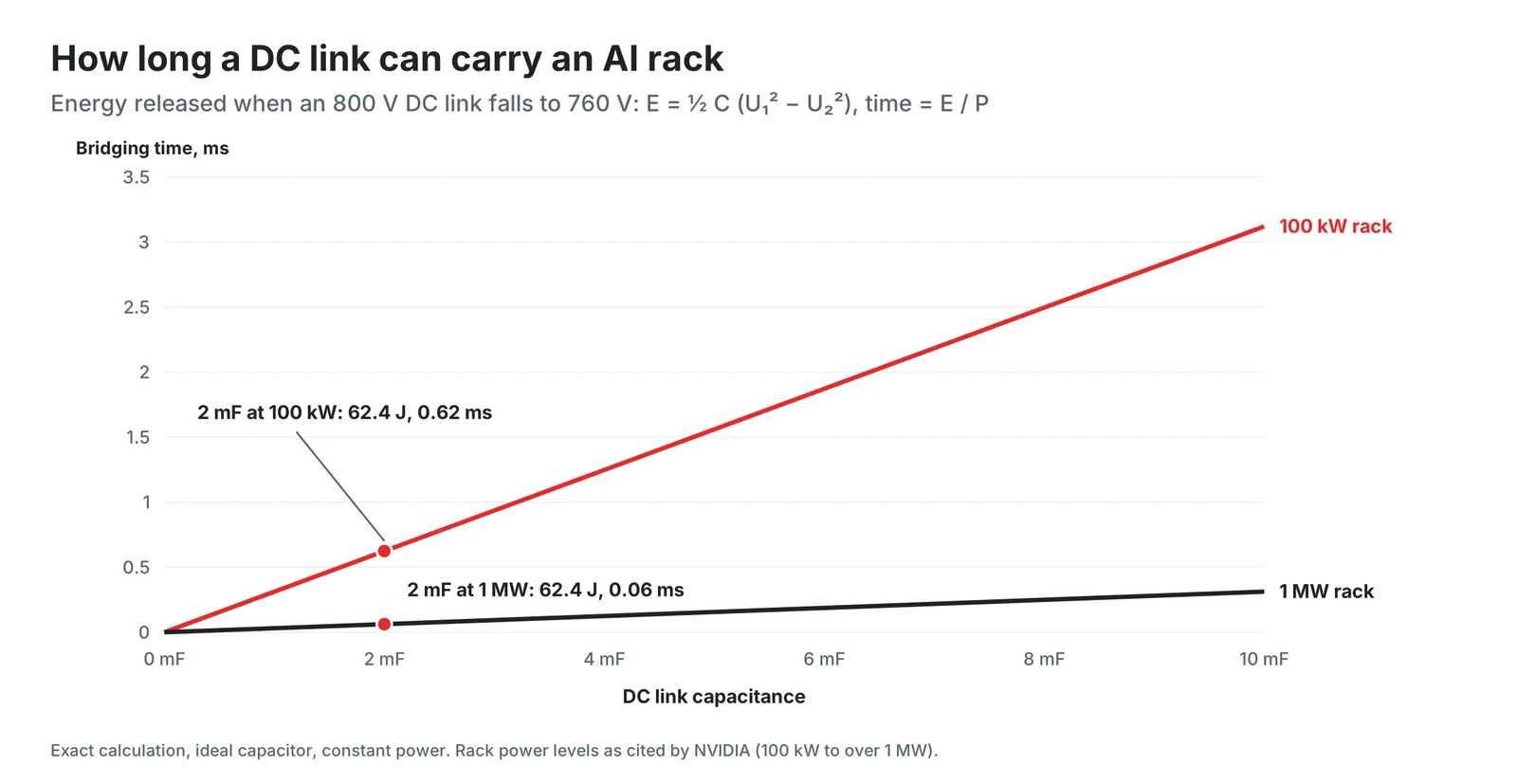
The energy stored in a capacitor is ½CU² (OpenStax, University Physics Volume 2, equation 8.10), so the energy it releases when its voltage falls from U₁ to U₂ is:
Take, as an example, a DC link of 2 mF on an 800 V bus that is allowed to fall by 5 % to 760 V. Then E = ½ × 0.002 F × (800² - 760²) V² = ½ × 0.002 × 62 400 = 62.4 J. A 100 kW rack consumes this energy in 0.62 ms, a 1 MW rack in 62 µs. To bridge 1 ms of a 1 MW rack within the same voltage window, the capacitance would have to be:
That is about thirteen capacitors of 2500 µF, the largest 900 V class part in the HYDRA DC-link datasheet, for one millisecond. The conclusion is clear: the film DC link handles ripple current, switching transients and the first tens to hundreds of microseconds of a load step. NVIDIA assigns the milliseconds to seconds range to high-power capacitors and supercapacitors close to the racks, and seconds to minutes to battery storage. The technologies complement each other.

Grid impact and power quality
A large data center is a large converter load, and the grid notices. IEEE 519-2022 establishes waveform distortion goals for systems with linear and nonlinear loads and applies its limits at the point of common coupling between the facility and the utility.
Voltage sensitivity works in the other direction as well. A NERC incident review published in January 2025 describes how, on 10 July 2024, about 1500 MW of data center-type load in the Eastern Interconnection transferred to backup power in response to a series of faults on a 230 kV line.
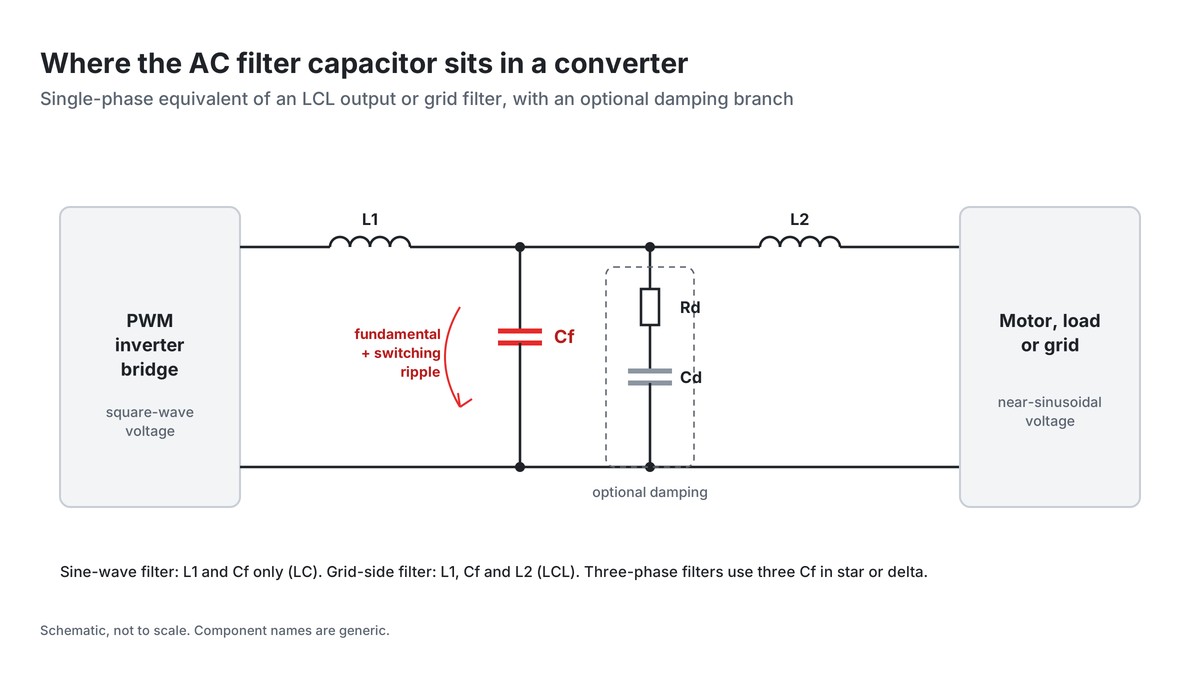
For capacitor designers, where AC distribution remains, PFC capacitors go into automatic, tuned or detuned banks with filter reactors, a topic covered in an earlier article in this series. Converters on the AC side need AC filter and DC-link capacitors rated for their ripple current.
What HYDRA offers for these positions
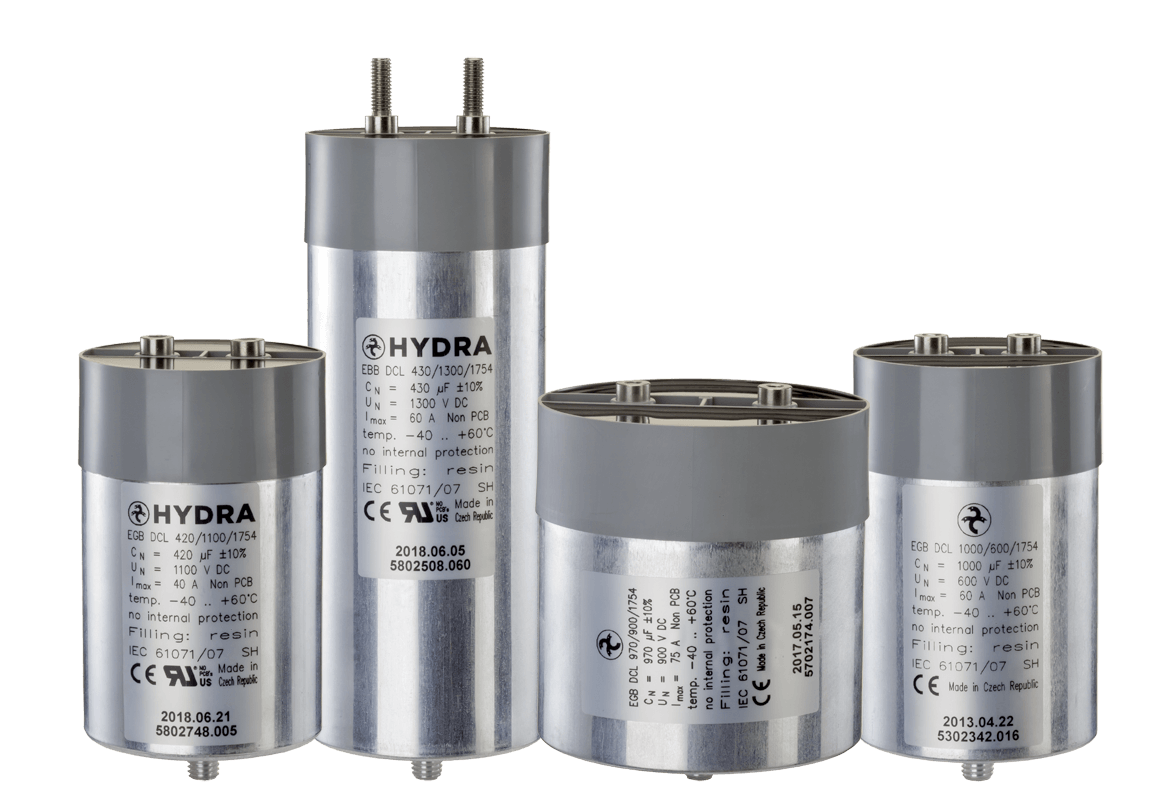
HYDRA DC-link capacitors are dry resin-filled metallized polypropylene capacitors from 700 to 1500 V DC and 120 to 2800 µF, with an inductance below 50 nH and a life expectancy of 100 000 h at rated voltage and a hot spot below 70 °C, according to the 2019 datasheet. The 900 V class covers an 800 V bus, including the full link of a ±400 V system, and the datasheet states that no series connections are necessary. The AC filter capacitors (series EAB, EBB, ERB and ECB) to IEC 61071 Ed. 2.0 and UL 810 list UPS systems and the damping of voltage spikes during the switching of power semiconductors among their applications. PFC capacitors are intended for automatic PFC equipment and tuned or detuned banks.
| Position | HYDRA product family | Key catalogue data |
|---|---|---|
| UPS, rectifier, SST DC link | DC-link | 700 to 1500 V DC, < 50 nH |
| UPS output, sine and LCL filters, snubbers | AC filter | 420 to 1400 V AC, up to 80 A |
| LV PFC and detuned filters | PFC | 230 to 690 V AC, 50/60 Hz |
Conclusion
AI data centers move power conversion out of the rack and towards higher DC voltages: 800 VDC in NVIDIA's architecture, ±400 VDC in the Open Compute Mt Diablo work. Capacitor positions shift towards larger converters with DC links in the 800 V class, SST cells, and power quality equipment at the grid connection. In the example above, a film DC link of 2 mF carries a megawatt rack for only about 60 microseconds. Its task is ripple current, stability and fast transients, while NVIDIA assigns milliseconds to minutes to supercapacitors and batteries. Each storage stage should be sized for its own time scale.
This article gives general design guidance. The final selection should always be confirmed with the capacitor manufacturer's datasheets and application engineers for the specific series and operating conditions.
HYDRA DC-link, AC filter and PFC capacitors and documents
The HYDRA DC-link datasheet lists rated voltages of 700, 900, 1100, 1300 and 1500 V DC, so a single 900 V class part covers an 800 V bus without series connection. The AC filter series in the HYDRA catalogue 2025 comply with IEC 61071 and UL 810, and the PFC series are rated for 50 Hz and 60 Hz networks.
Further documents:
- DC-link capacitors EGB DCL and EBB DCL datasheet (PDF), with the full product table
- HYDRA capacitors catalogue 2025 (PDF), with DC-link, AC filter and PFC capacitors
- Components for power factor correction (PDF): filter reactors, PFC controllers, fuses and capacitor switching contactors
- HYDRA products
- Documents and certificates: ISO 9001, RoHS and REACH
- Contact
References
- M. Blake, M. Hsu, I. Goldwasser, H. Petty, J. Huntington, NVIDIA 800 VDC Architecture Will Power the Next Generation of AI Factories, NVIDIA Technical Blog, 20 May 2025.
- N. Srivastava, H. Petty, Building the 800 VDC Ecosystem for Efficient, Scalable AI Factories, NVIDIA Technical Blog, 13 October 2025.
- M. Iyengar, A. Huffman, Enabling 1 MW IT racks and liquid cooling at OCP EMEA Summit, Google Cloud Blog, 29 April 2025.
- T. Zedníček (ed.), Industrial Passive Components Markets and Technologies 2026, EPCI passive-components.eu, 21 May 2026, based on research by Paumanok Inc. and TTI Europe.
- Wolfspeed, Powering AI with reliable silicon carbide based solid-state transformers, Wolfspeed Knowledge Center, 2026.
- IEEE 519-2022, IEEE Standard for Harmonic Control in Electric Power Systems, abstract and scope. IEEE Standards Association.
- American Public Power Association, NERC incident review examines risks, challenges tied to integration of large loads, 9 January 2025.
- NERC, Incident Review: Considering Simultaneous Voltage-Sensitive Load Reductions, January 2025.
- H. Wang, F. Blaabjerg, Reliability of Capacitors for DC-Link Applications in Power Electronic Converters: An Overview, IEEE Transactions on Industry Applications 50(5), 2014. Aalborg University repository.
- OpenStax, University Physics Volume 2, 8.3 Energy Stored in a Capacitor. Rice University, CC BY 4.0.
- HYDRA a.s., HYDRA capacitors catalogue 2025 (DC-Link, AC Filter and Power Factor Correction Capacitors).
- HYDRA a.s., DC Link Capacitors EGB DCL/EBB DCL datasheet, edition 01/2019.
- HYDRA a.s., Components for power factor correction.
Products in this article
DC link & power electronics
Check stockAsk a HYDRA engineer
Send us your application data and our engineers will help you choose the right film capacitor. HYDRA has made film capacitors since 1899, with production in Jičín (Czech Republic) and Da Nang (Vietnam).
Ask an engineerCheck stock