Where Film Capacitors Work in a Data Center: From the Utility Feed to the Cooling Plant
In this article
A data center is two plants under one roof: a power plant that delivers uninterrupted electricity to the IT load, and a cooling plant that removes the same energy again as heat. According to the International Energy Agency, as reported by the International Institute of Refrigeration (IIR), electricity demand from data centers worldwide is set to more than double by 2030 to around 945 TWh. The IIR itself states that 30 % to 55 % of the energy consumption in data centers is used for cooling. The Uptime Institute reports a weighted average annual PUE of 1.54 for 2025, the sixth consecutive year in which the figure has virtually stood still. A PUE of 1.54 means that 0.54 / 1.54 = 35 % of the facility energy does not reach the IT equipment.
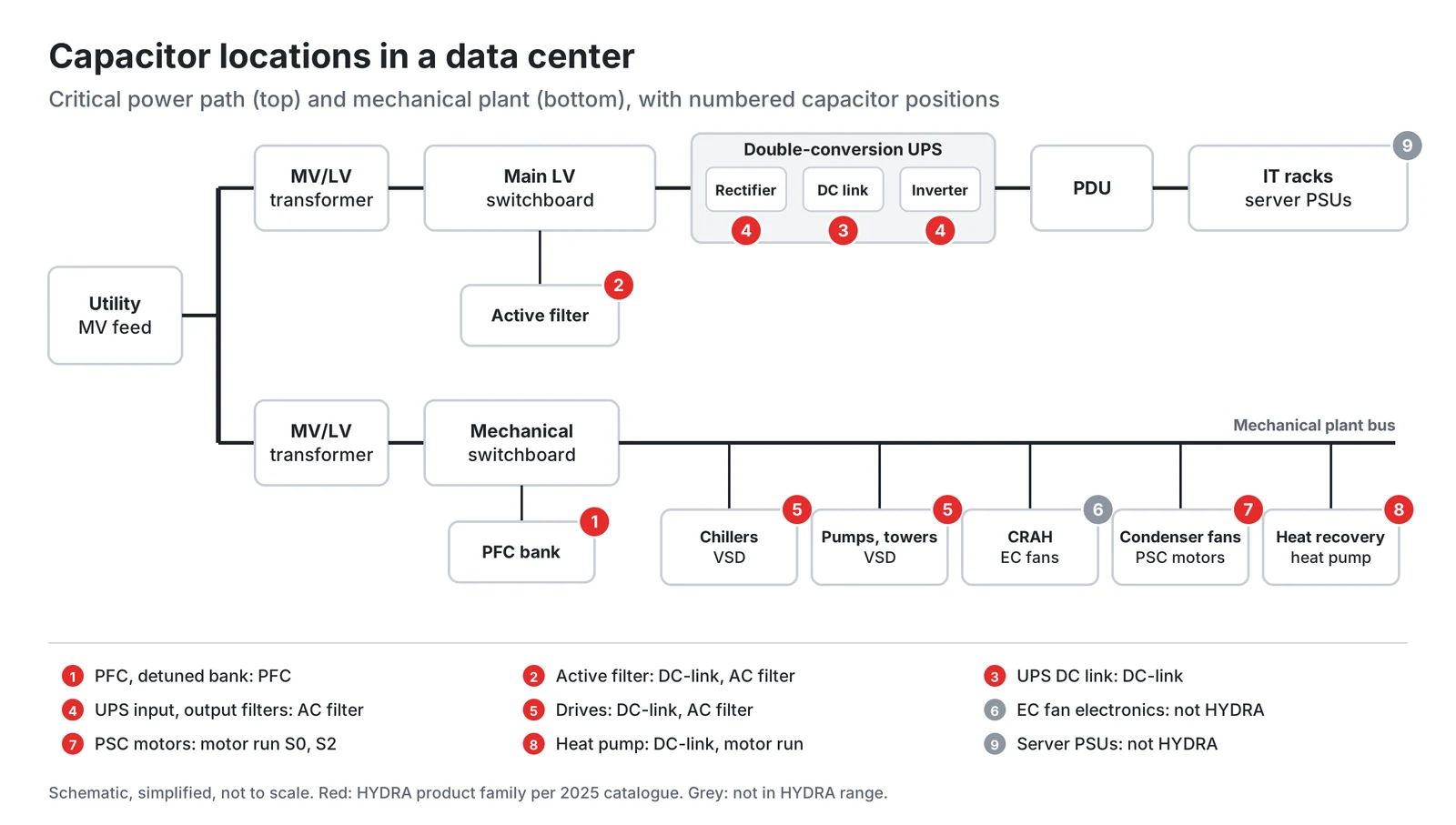
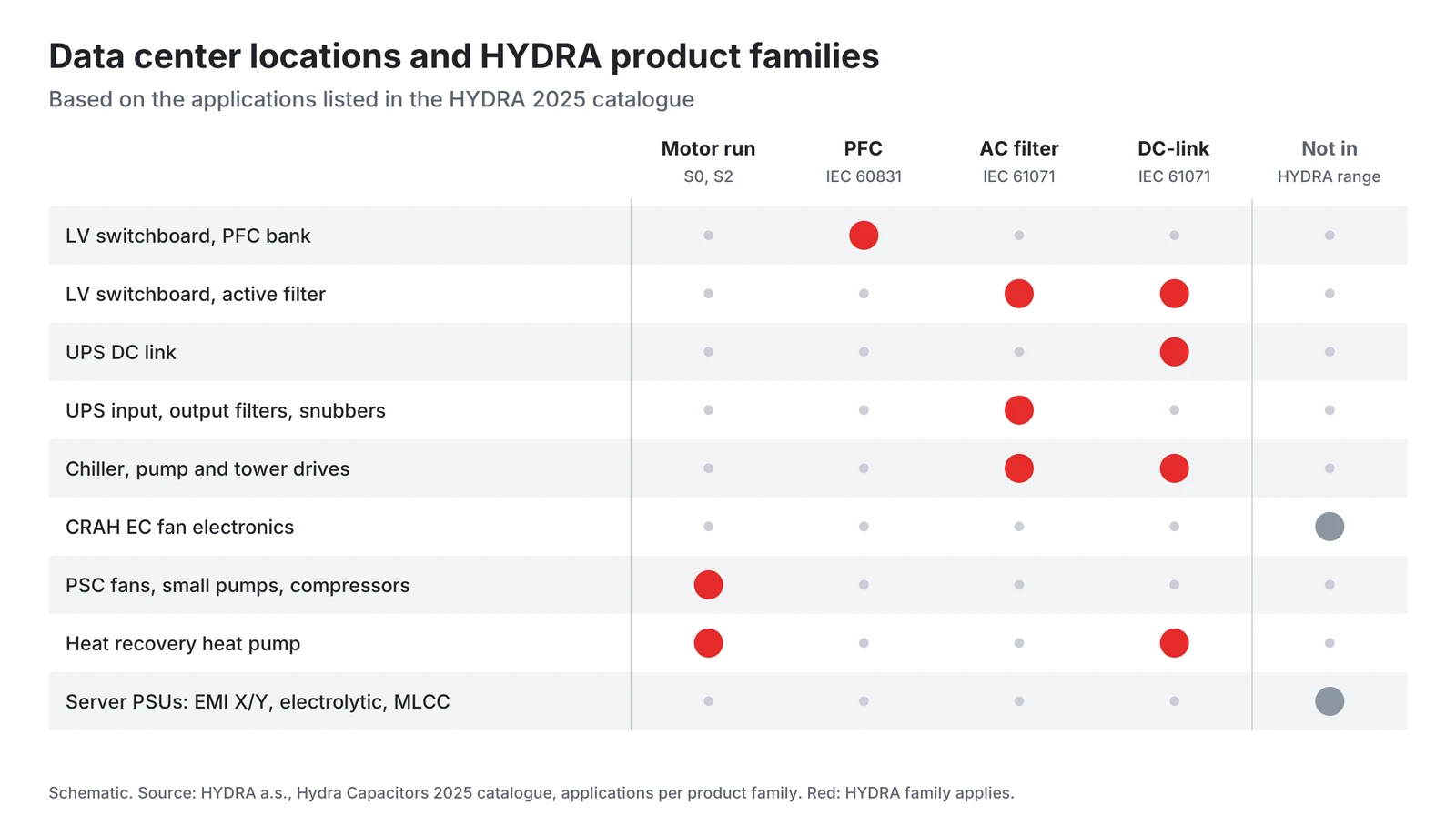
An earlier article in this series followed the AI power chain towards 800 VDC distribution. This article takes the whole facility, from the utility feed to the dry coolers on the roof, maps each film capacitor position to a HYDRA product family (Figure 1) and states plainly where HYDRA has no product.
Key takeaways
- Film capacitors in a data center are spread across both plants.
- On the power side they compensate and filter at the main switchboard and carry the DC link and AC filters of UPS systems and active filters.
- HYDRA covers PFC, AC filter, DC-link and motor run positions, but not the capacitors inside IT equipment and EC fan electronics.
The power side
Main low voltage switchboard. The HYDRA catalogue lists low voltage automatic power factor correction cabinets and detuned or tuned capacitor banks among the applications of its PFC capacitors. HYDRA PFC capacitors (series PAB, PMB and PRB) cover 230 to 690 V AC at 50 or 60 Hz with up to 56 kvar per unit, filled with oil, soft resin or nitrogen gas, with overpressure disconnectors and conformity to IEC/EN 60831-1/2. Filter reactors (detuning 5.67 to 14 %), switching contactors and controllers complete the bank.
Product data for current large and modular double-conversion UPS systems give an input power factor above 0.99 and input current THD below 3 %. Where the bank shares the bus with variable speed drives and other static converters, the HYDRA documentation for PFC components describes filter reactors combined with capacitors in detuned or tuned filters, because harmonics can cause PFC capacitor failures from overloading and system resonance. Detuning was discussed in an earlier article in this series.
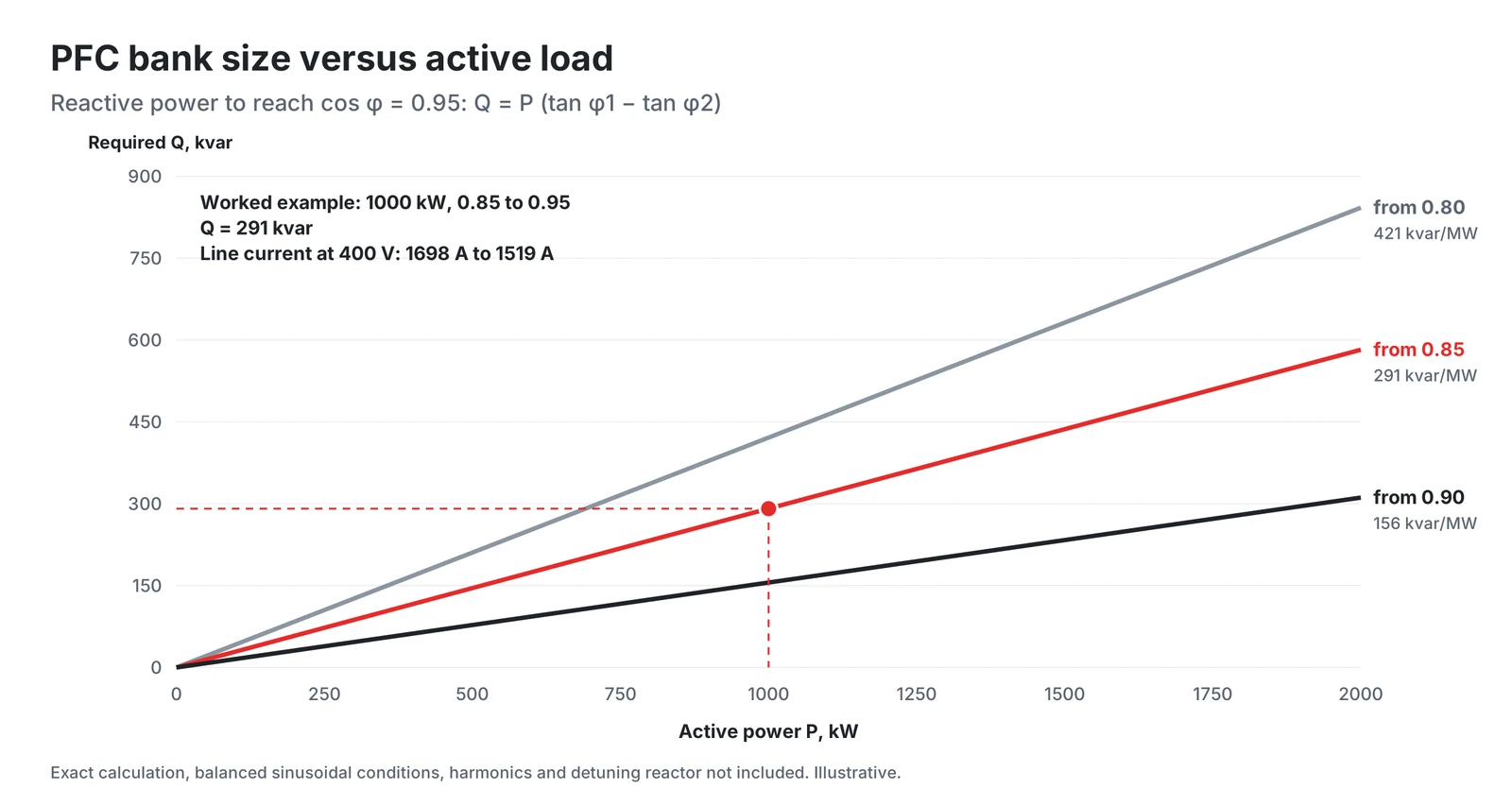
The capacitor rating equals the reactive power before correction minus the reactive power after correction at the same active power, as in the Eskom power factor sizing guide. With the reactive power written as P × tan φ, the size of the bank follows from the active power P and the power factor before and after compensation:
For an assumed mechanical plant drawing 1000 kW at cos φ = 0.85, raising the power factor to 0.95 needs 1000 × (0.620 - 0.329) = 291 kvar. At an assumed 400 V the line current I = P / (√3 × U × cos φ) falls from 1698 A to 1519 A, by 10.5 %. Because losses are proportional to the square of the current, as the Eskom guide notes, the resistive losses in the feeders fall by about 20 %. Figure 2 shows how the required bank grows with load for three starting power factors.
Active harmonic filters. Where distortion must be reduced, an active harmonic filter can be installed at the switchboard. HYDRA lists active filters among the applications of both its DC-link and AC filter capacitors.
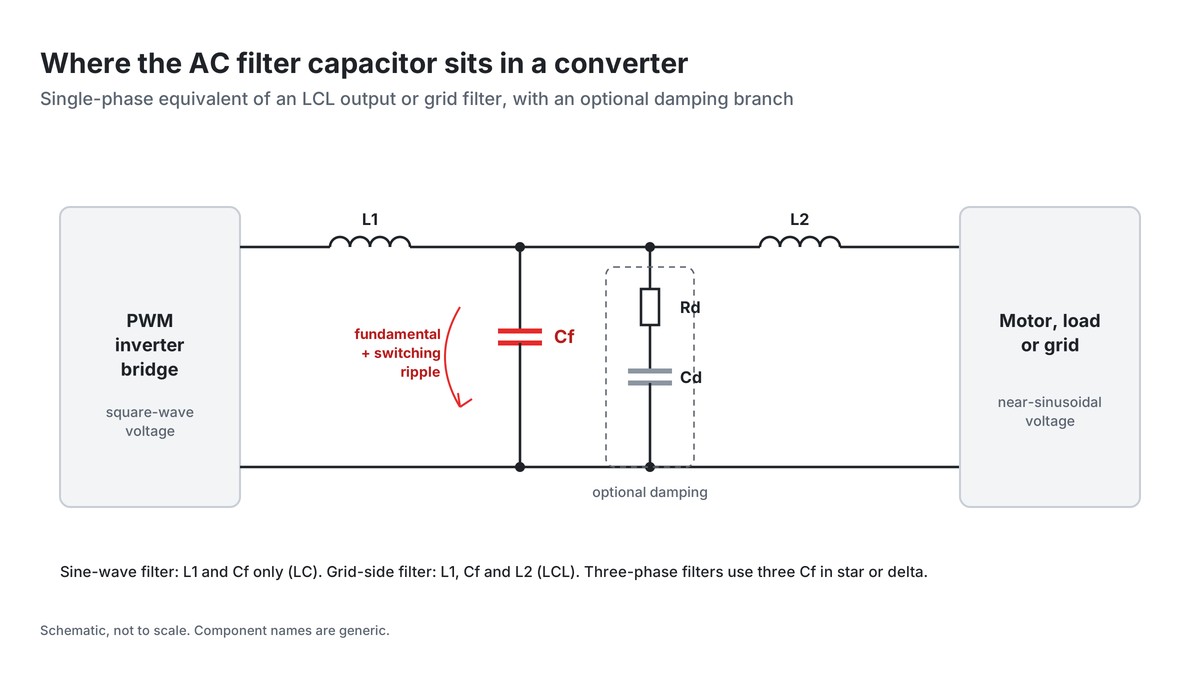
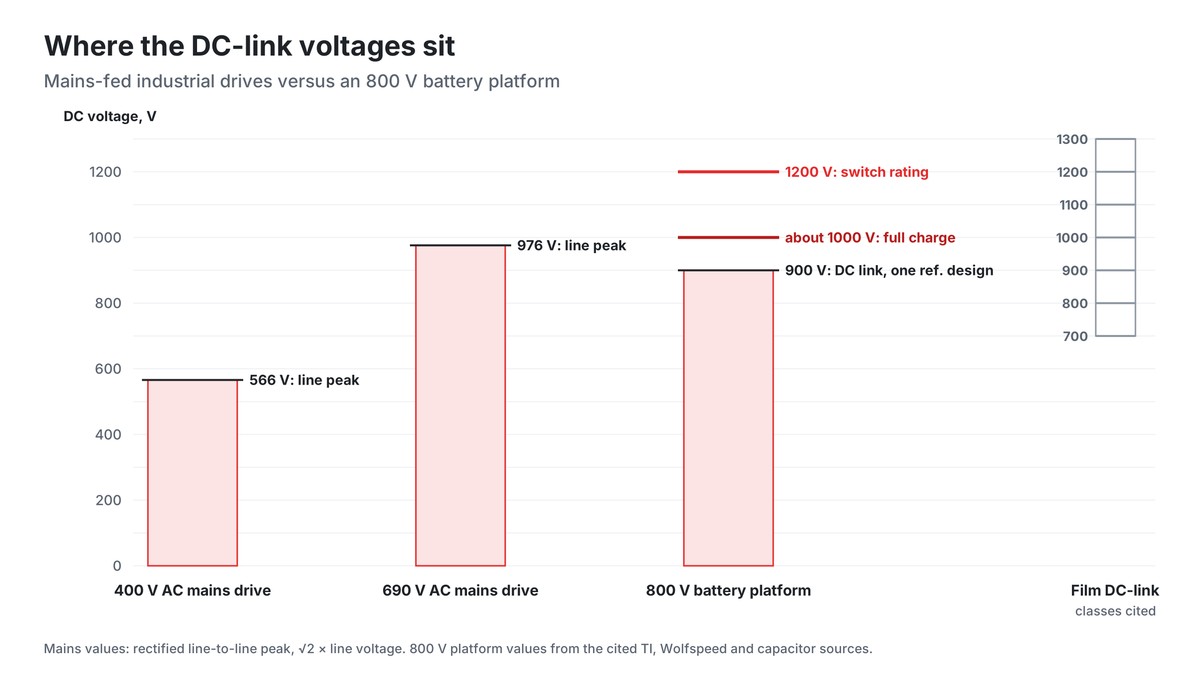
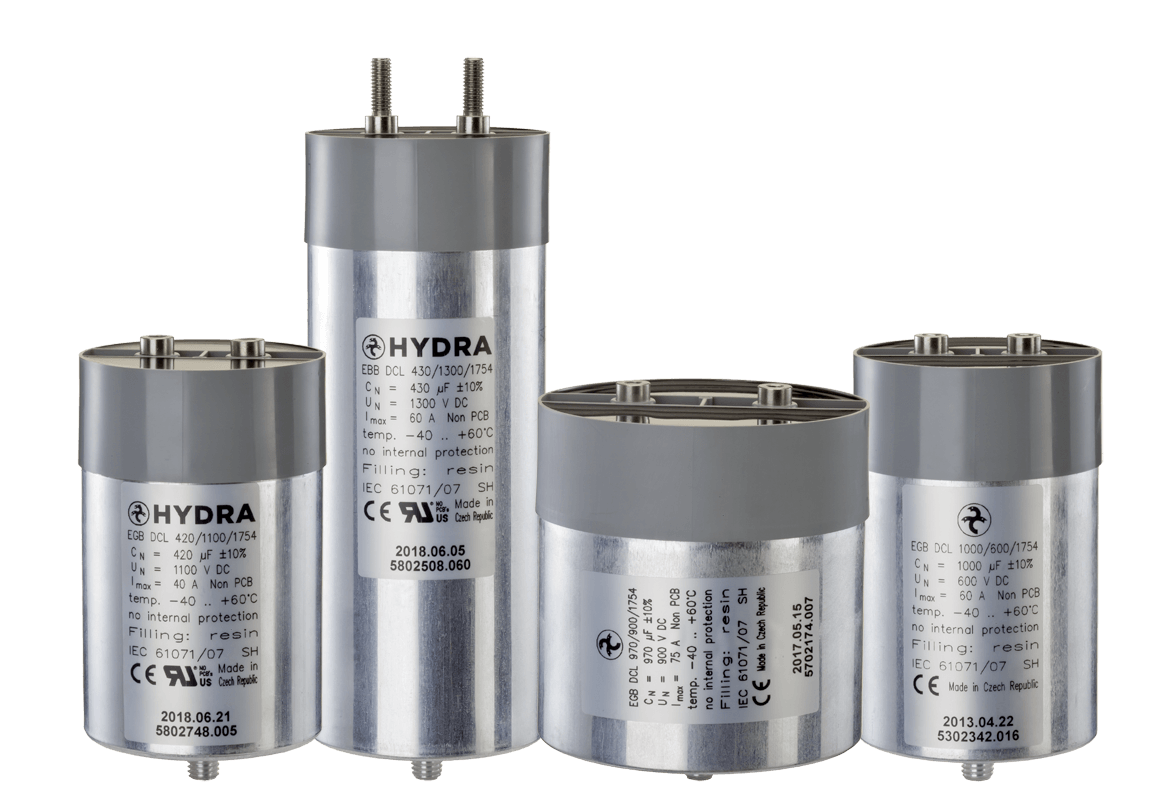
UPS. A double-conversion UPS rectifies, holds a DC link and inverts back to a sine wave. HYDRA DC-link capacitors (series EGB DCL and EBB DCL) are dry, resin-filled metallized polypropylene parts from 700 to 1500 V DC and 120 to 2800 µF with inductance below 50 nH, to IEC 61071. For input and output filters and spike damping, HYDRA AC filter capacitors (series EAB, EBB, ERB and ECB) cover 420 to 1400 V AC and currents up to 80 A, to IEC 61071 Ed. 2.0, and the catalogue names UPS systems, snubber duty and thyristor commutation as applications.
IT racks. Capacitors inside servers and their power supplies are outside the HYDRA range. HYDRA makes no EMI suppression, aluminium electrolytic or ceramic capacitors.
The cooling side
In the mechanical plant, regulation and efficiency guidance push towards variable speed. Commission Regulation (EU) 2019/1781 has required IE2 efficiency or better for speed controllers driving motors from 0.12 to 1000 kW, and since 1 July 2023 it also requires IE2 for single-phase motors of 0.12 kW and above. ENERGY STAR recommends variable speed fan drives wherever possible in data centers, because fan power varies with the cube of speed, so a fan at half speed uses one eighth of the energy. The HYDRA catalogue lists power drives among the applications of its DC-link capacitors and AC/DC power converters among those of its filter capacitors.
ENERGY STAR describes electronically commutated (EC) fans as inherently more efficient than traditional centrifugal fans and 100 % speed controllable without added components. HYDRA does not make board-mounted capacitors for fan electronics.
The permanent split capacitor (PSC) motor has not disappeared. PNNL describes it as until recently the most popular fan motor for furnaces, air handlers, condensing units and packaged units, known for simplicity, reliability and low cost. The HYDRA catalogue lists single-phase motors for white goods, pumps, compressors and fans as applications of its motor capacitors: series MKP in class S0 with resin filling (0.8 to 40 µF) and MKP-SI in class S2 with vegetable oil and an overpressure disconnector (1 to 160 µF), both 400 to 500 V AC to EN 60252-1/2.
Heat recovery. Article 26(6) of the EU Energy Efficiency Directive (EU) 2023/1791 requires Member States to ensure that data centers with a total rated energy input above 1 MW use their waste heat or other waste heat recovery applications, unless they show this is not technically or economically feasible. A 2025 ICEF roadmap notes that heat from air-cooled halls is close to ambient and often impossible to reuse, while liquid cooling delivers it at 45 to 70 °C, and heat pumps raise it for district heating.
Reliability requirements
The Uptime Institute defines Tier III as concurrently maintainable, with redundant components and distribution paths, and Tier IV as fault tolerant, with independent, physically isolated systems. Uptime also reports that power remains the leading cause of impactful outages. For capacitors this means three demands.
First, a long, predictable life, so that replacement falls into planned maintenance windows. The HYDRA DC-Link datasheet states 100 000 h for DC-link capacitors at rated voltage and a hot spot below 70 °C, and the catalogue gives 100 000 h for AC filter capacitors and from over 100 000 h to over 150 000 h for PFC capacitors with 5000 switching operations per year, depending on series. 100 000 h is about 11 years of continuous operation.
Second, a safe end of life. Self-healing metallized polypropylene clears local breakdowns of the film, and the overpressure disconnector in PFC, AC filter and S2 motor capacitors separates the element from the supply when internal pressure rises. HYDRA motor capacitors are rated in classes of operation from A (30 000 h) to D (1000 h), which should match the running hours of a plant that never stops.
Third, a known thermal environment. The catalogue limits for PFC capacitors are 55 or 60 °C maximum ambient, with 24 h averages of 45 or 50 °C and annual averages of 35 or 40 °C depending on series. Electrical rooms and cabinets must keep these limits even when part of the cooling fails.
Mapping the facility
| Location | Function | Capacitor type | Standard | HYDRA family |
|---|---|---|---|---|
| LV switchboard | PFC, detuned bank | MKP, oil, soft resin or N2 | IEC 60831-1/2 | PFC: PAB, PMB, PRB |
| LV switchboard | Active harmonic filter | DC link, AC filter | IEC 61071 | DC-link, AC filter |
| UPS | DC link | Dry MKP | IEC 61071 | EGB DCL, EBB DCL |
| UPS | Input, output filter, snubber | MKP, oil or resin | IEC 61071 | EAB, EBB, ERB, ECB |
| Chiller, pump, tower drives | DC link, filters | MKP | IEC 61071 | DC-link, AC filter |
| CRAH EC fans | Fan electronics | Not covered here | Not covered here | Not in HYDRA range |
| PSC fans, small pumps, compressors | Motor run | MKP, S0 or S2 | EN 60252-1/2 | Motor: MKP, MKP-SI |
| Heat recovery heat pump | Drive DC link, motor run | MKP | IEC 61071, EN 60252 | DC-link, Motor |
| Server PSU and boards | IT equipment | Not covered here | Not covered here | Not in HYDRA range |
Conclusion
Film capacitors in a data center are spread across both plants. On the power side they compensate and filter at the main switchboard and carry the DC link and AC filters of UPS systems and active filters. On the cooling side, EU rules and ENERGY STAR guidance favour variable speed drives, which use DC-link and filter capacitors, while PSC motors with run capacitors remain in single-phase fans, pumps and compressors. Heat reuse, required for sites above 1 MW in the EU unless shown infeasible, adds heat pumps. HYDRA covers PFC, AC filter, DC-link and motor run positions, but not the capacitors inside IT equipment and EC fan electronics.
This article gives general design guidance. The final selection should always be confirmed with the capacitor manufacturer's datasheets and application engineers for the specific series and operating conditions.
HYDRA capacitors for data center power and cooling and documents
HYDRA makes the four film capacitor families mapped above, all in metallized polypropylene. The ranges below are those stated in the 2025 catalogue and, for DC-link, in the DC-Link datasheet. Filter reactors, capacitor switching contactors, PFC controllers and fuses for complete PFC banks are described in a separate document.
| Family | Series | Rated voltage | Standard |
|---|---|---|---|
| Power factor correction | PAB DPM, PMB DPM, PRB DPM, PRB DPMg | 230 to 690 V AC, 1 to 56 kvar | IEC 60831-1/2 |
| AC filter | EAB MKP, EBB MKP, ERB DPM, ECB DPM | 420 to 1400 V AC, up to 80 A | IEC 61071 |
| DC-link | EGB DCL, EBB DCL | 700 to 1500 V DC, 120 to 2800 µF | IEC 61071 |
| Motor run | MKP (S0), MKP-SI (S2) | 400 to 500 V AC | EN 60252-1/2 |
Further documents:
- HYDRA capacitors catalogue 2025 (PDF), with parameters and applications of all four families
- DC-Link capacitors EGB DCL and EBB DCL datasheet (PDF)
- Components for power factor correction (PDF): filter reactors, contactors, controllers and fuses
- Product overview and stock types
- Documents and certificates: VDE certificates, ISO 9001, RoHS and REACH
References
- International Institute of Refrigeration, AI set to drive doubling of electricity demand from data centres, news citing IEA, Energy and AI (April 2025).
- Uptime Institute, Uptime Institute Global Data Center Survey 2025, UII Keynote Report 180, July 2025.
- HYDRA a.s., Hydra Capacitors 2025, product catalogue (DC-Link, AC Filter, Power Factor Correction and Motor Running Capacitors), 2025.
- HYDRA a.s., Components for Power Quality: filter reactors, PFC controllers, fuses, capacitor switching contactors (ed. 02/13).
- HYDRA a.s., DC Link Capacitors EGB DCL / EBB DCL, datasheet ed. 01/19.
- Nova Electric, NERM-C Series 20 to 800 kVA three phase modular true online UPS, product page, checked 18 October 2026.
- Power Systems Design, AEG Power Solutions updates Protect Blue UPS for large data centers, 10 November 2015.
- Eskom, Power factor: Sizing guide, fact sheet (PDF), examples 4 and 9.
- Commission Regulation (EU) 2019/1781 laying down ecodesign requirements for electric motors and variable speed drives, EUR-Lex, requirements as summarised by eceee.
- ENERGY STAR, Replace standard fans with variable speed fans.
- Pacific Northwest National Laboratory, Building America Solution Center, ECM Air Handler Fans, updated 7 October 2022.
- Directive (EU) 2023/1791 of the European Parliament and of the Council of 13 September 2023 on energy efficiency, Article 26(6), EUR-Lex.
- Innovation for Cool Earth Forum (ICEF), Sustainable Data Centers Roadmap, Chapter II.4 Heat Reuse, October 2025.
- Uptime Institute, Tier Classification System.
- Uptime Institute, Uptime Announces Annual Outage Analysis Report 2025, press release, 6 May 2025.
- R. Gallay, Metallized Film Capacitor Lifetime Evaluation and Failure Mode Analysis, CERN Yellow Reports CERN-2015-003, open access, also arXiv:1607.01540.
Products in this article
DC link & power electronics
Check stockAsk a HYDRA engineer
Send us your application data and our engineers will help you choose the right film capacitor. HYDRA has made film capacitors since 1899, with production in Jičín (Czech Republic) and Da Nang (Vietnam).
Ask an engineerCheck stock